
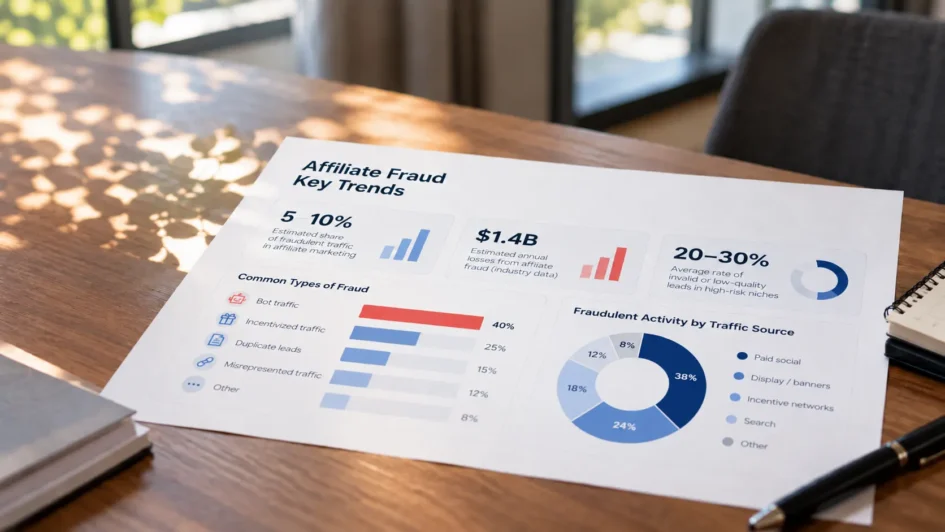
The best way to reduce affiliate marketing fraud risk in CPA campaigns is to use more than one control. No single control can independently verify the traffic source, its legitimacy, conversion eligibility, and whether suspicious activity should ultimately be classified as fraud.
Adverten is a Smartlink CPA affiliate network and traffic processing and monetization system. Public documentation of Adverten describes partner activation, traffic-source requirements, tracking and postbacks, daily traffic monitoring, anti-fraud processing, conversion verification, the investigation process, and two-factor authentication. Smartlink routing itself cannot be considered a fraud protection mechanism. At the same time, Adverten has developed its own anti-fraud solution as a separate project integrated into Smartlink to check affiliate traffic quality.
TL;DR
- Best for protecting against unknown or misrepresented traffic: traffic verification by partnering with and verifying the traffic sources themselves.
- Best for figuring out where suspicious activity originated: tracking IDs, sub-IDs, campaign parameters, and postbacks.
- Best for discovering irregular behavior: ongoing monitoring of traffic at the source level and segment level.
- Best for solving lead and conversion quality issues: eligibility testing, duplication checking, and conversion validation.
- Best for acquisition through banned techniques: affiliate fraud detection based on campaign rules.
- Best as a supplementary fraud detection technique: anti-fraud technologies in combination with traffic and conversion context.
- Best for minimizing unauthorized account activity: account controls and two-factor authentication.
- No single KPI, tool, or traffic anomaly can be taken as proof of fraud alone.
Table of Contents
- Best CPA Affiliate Fraud Prevention Practices at a Glance
- Source Verification and Pre-Launch Fraud Prevention
- Tracking, Monitoring, Validation, and Security Controls
- Examples: Choosing the Right Fraud Prevention Practice
- Common Affiliate Fraud Prevention Mistakes
- Expert Tips for Combining Fraud Prevention Controls
- Affiliate Fraud Statistics and Metrics That Matter
- Adverten’s Public Fraud Prevention Framework
- Conclusion: Build a Layered Fraud Prevention Strategy
- CPA Affiliate Fraud Prevention FAQ
Introduction
Campaigns based on CPA (cost-per-action) pay for predefined actions like registration, lead, subscription, or sale. Thus, multiple control checkpoints are needed regarding the quality of traffic, attribution, participation eligibility, and compliance. A legitimate click does not guarantee a legitimate lead. A poor-performing traffic source is not necessarily fraudulent. A high conversion rate may result from improved targeting, positioning, tracking, or prohibited activities.
Effective affiliate fraud monitoring requires combining these controls according to the risk involved. First, identify the kind of risk, and then select the corresponding practice that provides the necessary evidence for your decision.
According to the Adverten affiliate traffic and compliance policy, self-generated or motivated leads, traffic generated by automated visitors using scripts or bots, traffic generated by manipulations of referer data, spam-related traffic or leads, and spyware traffic are not acceptable. It is also allowed to verify traffic quality via links, screenshots, promotional materials, and a general description of the process used for traffic generation. These rules reflect a crucial point: traffic quality checks, attribution, compliance, and conversion validation address various fraud issues.
Best CPA Affiliate Fraud Prevention Practices at a Glance

Understanding how to prevent affiliate fraud starts with matching the control to the problem being investigated. The comparison below shows which practice fits each risk and what its evidence can establish.
| Fraud prevention practice | Best for | Main evidence used | Key limitation |
|---|---|---|---|
| Partner verification | Unknown or unverified partners | Registration and partner information | Does not validate every future traffic event |
| Traffic-source verification | Misrepresented or unapproved acquisition methods | Source details, links, placements, screenshots | Depends on accurate disclosure and review |
| Tracking IDs and sub-IDs | Isolating suspicious segments | Campaign, source, placement, creative identifiers | Poor naming or incomplete tagging reduces value |
| Postback validation | Reconciling conversions and attribution | Server-to-server conversion events and IDs | Correct attribution does not prove eligibility |
| Continuous monitoring | Detecting abnormal traffic or conversion patterns | Clicks, conversions, GEO, device, source, timing | An anomaly is a signal, not proof |
| Conversion validation | Duplicate, ineligible, or disputed actions | Conversion IDs, rules, advertiser validation | Requires clear eligibility criteria |
| Affiliate compliance monitoring | Prohibited traffic methods or campaign-rule breaches | Source evidence and documented restrictions | Compliance breach and fraud are not always identical |
| Anti-fraud analysis | Additional detection and prioritization | Technical and behavioral risk signals | Scores or alerts require context |
| Account security | Unauthorized access and account misuse | Authentication and account-change information | Does not replace traffic-quality controls |
Best for Preventing Unknown Traffic: Source Verification
The most efficient preventative control in cases when there is uncertainty about the traffic origin and user acquisition is traffic-source verification. This advantage holds until the campaign launches and traffic volumes are generated.
A good traffic-source verification scheme includes:
- the type of traffic source;
- expected GEOs and placements;
- promotion technique;
- using incentives;
- need for further approval of the source;
- the data to prove the source in case traffic will have to undergo further checking.
This measure becomes particularly relevant when multiple websites, placements, purchase sources, or promotion techniques belong to the same partner account. With separate records, it is easy to analyze a particular suspicious part without considering all traffic sources as equal.
The obvious weakness of traffic-source verification is the following: the approved traffic source may still provide invalid or low-quality traffic. Traffic-source verification should be regarded as the best initial filter of source transparency.
Best for Finding the Problem Segment: Granular Tracking
Tracking is best applied when the issue is the location of suspicious activity. The tracking technique will help distinguish between:
- individual traffic sources;
- placements and creatives;
- variations in campaigns or funnels;
- sub-IDs and other valuable traffic segments.
When a conversion-quality problem occurs in one placement, the team can focus on that placement instead of stopping all sources. Adverten’s educational materials on affiliate network connections between advertisers and publishers explain this further.
Best for Questionable Conversions: Validation
Conversion validation is the best strategy if the primary consideration is whether the attributed conversion fulfills the campaign guidelines. Attribution and eligibility are distinct issues. A conversion may be attributed accurately to the publisher, yet still be a duplicate, ineligible, or non-conforming conversion under the campaign guidelines.
The validation process needs to check the conversion against the criteria for eligibility, duplication, GEO, targeting, and advertiser. High lead volume or a low approval ratio won’t reveal the issue: incorrect targeting, motivated leads, duplicates, fake submissions, and eligible leads that are ineligible may all look the same in high-level statistics. The choice must be based on the connection between each problematic conversion and its source.
Best Overall Strategy: Layered Controls
No single method can mitigate CPA fraud. A more comprehensive approach is better in that each individual control can provide the answer to a specific question.
- Verification: Who sends the traffic and how?
- Tracking: Where does this click/conversion come from?
- Monitoring: What has changed, and where is the anomaly concentrated?
- Validation: Is this a conversion?
- Compliance monitoring: Was a valid traffic source and campaign rule used?
- Anti-fraud analysis: Are there technical/behavioral indicators requiring further investigation?
- Account security: Is this a legitimate activity performed by an authorized user?
A fraud score is not necessary. The idea is just to have enough independent proof to distinguish invalid activity without endangering legitimate traffic.
Source Verification and Pre-Launch Fraud Prevention

Pre-launch control defines what legitimate behavior looks like and helps preserve the original data needed for further analysis. This is also where affiliate compliance checks begin: permitted traffic sources, reward policies, referrer requirements, and other restrictions must be clearly defined to be checked. Adverten obliges its partners to be activated and provides guidelines for traffic sources and prohibited actions.
Partner Verification
Use partnership verification when there is uncertainty about the nature of the publisher relationship. In this case, the aim is to determine:
- Who the partners will be;
- What types of traffic sources we will get;
- The GEOs and top placements expected;
- The methods of promotion;
- Any traffic source requiring approval.
According to Adverten, activation of partners is essential for participation in any program. Verification helps the account manager understand the nature of the traffic in future quality discussions, but onboarding is just the minimum.
Traffic-Source Verification
Traffic source verification is more detailed than partner verification because it looks at how users arrive at the offer and whether this channel of acquisition is consistent with the declared and approved configuration.
Adverten terms permit different types of traffic and say that others must be approved. Adverten also says affiliates must submit links, screenshots, advertising materials, and a general description of the traffic-generation channel. So traffic source verification can be very helpful when observed traffic does not match expectations.
Traffic source documentation must be detailed enough to differentiate between various placements, sites, media buys, etc. A description of a traffic source like “paid traffic” will probably not be sufficient to check. Traffic source verification must also be reconsidered when there is a change in the acquisition channel.
Campaign Rules and Compliance Controls
Affiliate compliance monitoring is the most suitable preventive measure when prohibited acquisition methods pose a greater risk than technical bot activity. Clear campaign rules create an objective benchmark for evaluating whether traffic sources and promotional methods are acceptable.
Some necessary restrictions should be made clear in advance in connection with the launch of the campaign:
- types of traffic sources approved/prohibited;
- GEO and device requirements, if any;
- incentivized/motivated traffic rules;
- requirements of referrer/source transparency;
- restrictions on creative and landing page;
- caps/conversion eligibility, if any;
- approval to use a new acquisition method, if any.
Adverten’s Terms of Service disallow motivated/self-generated leads, automated activity through scripts/bots, spoofing/referrer link manipulation, spam-based lead generation, and spyware.
In addition to the above, email traffic has some additional legal regulations. The Compliance Guide for Commercial Email, as provided by the U.S. Federal Trade Commission for CAN-SPAM regulations, provides information about requirements for commercial email. This includes proper header information, a non-deceptive subject line, an opt-out option, and timely responses to opt-out requests.
Strengths and Limits of Pre-Launch Controls
Pre-launch controls tend to be most effective at reducing uncertainty. Pre-launch controls define the partner, expected traffic, allowed sources, and actions that could be seen as a violation of campaign rules.
However, pre-launch controls have limitations that should not be ignored. Verifications will not guarantee that all future users are legitimate. The partner may add other placements even when not allowed, tracking may be set up incorrectly, and legitimate sources may generate ineligibles. Compliant sources may also work badly and not fraudulently.
This is why pre-launch controls work best when used with source identifiers and post-launch monitoring. When the threat comes from an unknown source, it is better to use verifications first. If the source is known but the problem is within one traffic source, prioritize tracking and monitoring.
Tracking, Monitoring, Validation, and Security Controls
Campaign live controls turn affiliate fraud detection into an evidence-based process. Aggregated data can indicate that something is happening but will not indicate which source, placement, GEO, device, creative, or conversion made the difference. Monitoring highlights what needs validation, validation confirms eligibility, and anti-fraud indicators help explain what’s happening.
The Media Rating Council standards on invalid traffic can serve as a wider framework for classification of invalid traffic in digital media measurement. CPA campaigns have their own rules of conversion, but the same approach remains valid.
Source-Level Tracking and Postback Validation
Source tracking is the optimal form of traceability. One possible system can include campaign ID, tracking ID, sub-ID, campaign parameters, conversion ID, timestamps, and postbacks where available.
The purpose of each one is:
- Tracking ID connects action with campaign information.
- Sub-ID distinguishes placements, creatives, websites, or traffic.
- Conversion ID assists with reconciliations and duplicates.
- Postback sends conversion actions between servers.
- Timestamps assist in analyzing traffic spikes and delays.
The Adverten’s CPA Network guide covers tracking URLs, postbacks, traffic quality, and conversions. It is especially useful when there is a need to compare multiple sources.
Continuous Traffic and Conversion Monitoring

Affiliate fraud monitoring is most useful for identifying changes worth investigating. Rather than comparing total clicks, conversions, or CR at campaign level, compare the relevant traffic segments.
Some dimensions worth monitoring include:
- source, sub-ID, and placement;
- GEO, device, and OS;
- creative, funnel, and offer;
- conversion type and time period;
- unexpected changes in volume, CR, or advertiser approval status.
The OWASP Logging Cheat Sheet stresses the importance of consistent logging for both security and operational analysis purposes. Similarly, it helps with CPA monitoring by collecting enough data to reconstruct the situation later.
Conversion Validation and Duplicate Checks
Conversion validation is ideal for evaluating whether the attributed action meets the criteria of the campaign. The need for this approach becomes more urgent when the traffic volume seems fine while approval, eligibility, or quality factors have been affected.
The review process of the conversion must link to:
- the conversion/transaction ID;
- the origin and placement of the conversion;
- GEO/device requirement relevant;
- whether there are duplicates;
- eligibility conditions of the campaign;
- dispute from advertiser or validation;
- tracking/postback relevant information.
It will be helpful in differentiating some situations that may seem alike in the reporting. The case of a duplicate conversion is different from fake leads; an eligible but actual user is different from bots; a tracking error is different from conversion fraud.
In affiliate marketing fraud investigations, validation is very powerful when the investigative team can elaborate on both the attribution and eligibility of the action.
Anti-Fraud Systems and Multiple Signals
Use affiliate fraud detection systems as an additional analytical layer, especially when campaign volume makes manual review difficult. Such systems can help score, classify, or highlight suspicious behavioral and technical signals for further investigation.
Adverten has developed its own anti-fraud checking system as a separate in-house project integrated into Smartlink. The system checks affiliate traffic quality and forms part of the company’s approach to CPA fraud prevention.
Alongside its proprietary development, Adverten’s Privacy Policy lists FraudScore among its third-party services. The company also states that it processes information that may be used to prevent fraudulent activity, including IP addresses, country, action logs, user agent, and traffic type.
The key disadvantage is that Adverten does not share with its partners the criteria for the fraud score calculation, precision of the anti-fraud detection, false positive rate, and also any internal blacklists and allowlists.
It is strongly recommended to correlate any anti-fraud signals with information from the source, campaigns’ rules, tracking results, and conversions. Any alert should be followed by manual review and not vice versa.
Account Security and Two-Factor Authentication
Account security works better against a different category of risks, namely unauthorized access. Campaign anomalies may arise as a result of the misuse of credentials, changes in the account, changes in tracking URLs, or payment settings, but not from the creation of fraud on purpose by the legitimate partner.
Adverten provides two-factor authentication for account security. In general, two-factor authentication and, more specifically, multifactor authentication are advised by the U.S. Cybersecurity and Infrastructure Security Agency, and businesses are advised to implement phishing-resistant authentication methods wherever feasible.
If you suspect an account compromise, traffic analysis should go hand in hand with an account access checkup. Questions to ask would be: who changed something, when, in what campaigns or payments settings, and which period of traffic could be impacted by these changes.
Account security does not replace affiliate fraud prevention efforts. It just secures another channel that produces abnormal campaign results.
Examples: Choosing the Right Fraud Prevention Practice

The examples are hypothetical in nature and not based on actual customers’ case studies. The guideline for prioritizing between validation and verification is straightforward – start by identifying the missing element first. If the source is known but there is some doubt regarding the conversion validity, then validation should come first. When the conversion is definitely valid, but the source is doubtful, verification comes next.
| Scenario | Best practice to prioritize | Why it fits | Supporting control |
|---|---|---|---|
| Source cannot be explained | Traffic-source verification | Establishes acquisition method and evidence | Compliance monitoring |
| One sub-ID suddenly changes | Granular tracking and monitoring | Isolates the affected segment | Anti-fraud analysis |
| High lead volume, low eligibility | Conversion validation | Tests whether actions meet rules | Source review |
| Declared source differs from observed source | Compliance and source verification | Compares evidence with approved method | Tracking review |
| Repeated or duplicate actions | Conversion and duplicate checks | Evaluates individual events | Tracking IDs |
| Unexpected account changes | Account security | Addresses unauthorized access risk | Activity review |
Best Practice for a Sudden Bot-Like Traffic Spike
The campaign enjoys consistent traffic via multiple placements, but an individual sub-ID starts delivering a disproportionately large amount of traffic at abnormal times. The first step to take should be source-level tracking and monitoring, since the initial challenge lies in localization.
Isolate the segment under consideration and compare the sources, times, GEOs, devices, user agents, and conversion behaviors with earlier periods. According to OWASP Business Logic Security recommendations, focus on observability and anomaly detection for business-value activities. In case there are multiple indications of automation and inconsistency between the source and campaign policies, limit the particular segment only.
Best Practice for High Lead Volume With Poor Eligibility
As the source starts producing a large number of leads, the advertiser’s acceptance becomes lower. In this situation, the first control to apply should be validating conversions, not classifying fraud right away.
First of all, the team should check the problematic conversions for compliance with the rules and find out whether it is related to the source, placement, GEO, device, or time frame. If needed, check for duplication from a data perspective. The promotional technique should be analyzed for possible motivation or violations of the campaign rules.
Broad targeting may produce legitimate but non-eligible users; motivated traffic could breach the campaign rules, and duplications and fakes would be the other case. If the validation reveals a violation of the rules, compliance control will be used as a supporting control.
Best Practice for a Referrer or Source Mismatch
The declared approved traffic source of a publisher differs from the tracking information available. The right way to go about it would be traffic source validation based on tracking information.
Before taking the matter further and considering it referrer manipulation, check the publisher against the declared traffic source using campaign parameters, redirects, landing pages, any available referrer data, screenshots, creatives, and any recent changes.
If the source of traffic can be matched and the traffic is valid, then the problem could be just technical. In case the publisher is not able to provide a source of traffic or there is clear evidence of its concealment or manipulation, then the relevant campaign and network rules could be applied.
Compliance monitoring is always more effective with technical context; source information without tracking might not be enough, as well as tracking information without a source.
Best Practice for Suspicious Account Activity
Unexpected locations, unusual traffic, altered tracking URLs, or strange account activity will definitely change the focus of attention from traffic quality analysis to something else. The first step here is to secure access, then look at the campaign period that was affected.
Make sure that access is secured, check recent changes, check who has accessed the account recently, and see whether some changes were made regarding payment, tracking, or campaign settings. Once the period is identified, traffic and conversions can be checked to see if there was any impact.
This situation is serious because suspicious campaign behavior doesn’t always come from how the publisher creates traffic.
Once access is secured, source tracking and validation can show whether there are special circumstances that affect this campaign period.
Common Affiliate Fraud Prevention Mistakes
In many affiliate marketing fraud investigations, the main weakness is poor process design rather than a lack of tools. A team may have detailed reports but no source-level tracking, anti-fraud alerts but no conversion IDs, or campaign restrictions without placement separation. This makes legitimate traffic harder to protect and suspicious activity harder to verify.
Knowing how to prevent affiliate fraud in practice means reducing ambiguity at every stage. All material sources need to be identifiable, important rules testable, conversions reconcilable, and fraud alerts connected to a defined review process.
Treating Conversion Rate as Proof of Fraud
Conversion rate can definitely help you detect something suspicious, but do not treat it as an independent factor for the traffic to be considered fraudulent.
An increased CR doesn’t always indicate fraud. It can be caused by better targeting, an improved offer, proper placement, a shorter funnel, or new tracking parameters. Similarly, a decreased CR can happen for various reasons: inappropriate audience, GEO, devices, caps on a campaign, etc.
If you notice a significant fluctuation in CR, take a comprehensive view of the matter. Compare traffic source, placement, GEO, devices used, offer, creative, conversion time, and advertiser confirmation. If the fluctuation is seen only within one particular traffic segment, it is worth examining this segment more closely. When the entire campaign undergoes changes following a well-known update, the reason is likely to be operational, and not fraud.
The right strategy is to treat CR as a red flag and then establish the real cause of fluctuations.
Scaling Before Traffic Quality Is Understood
Scaling may exaggerate hidden quality issues. With a poorly segmented source, increasing volume makes it even harder to identify the placement causing the problem. If there are problems with postback, the more conversions, the greater the attribution issues.
Before scaling traffic, make sure the source and all important placements are approved, tracking IDs are used correctly, conversion conditions are known, and potential quality or compliance issues aren’t hidden in aggregated statistics.
In Adverten’s educational materials devoted to the way CPA affiliate networks help publishers generate traffic revenues, there is a lot of information about the importance of sub-IDs, postbacks, conversions, and collecting enough statistics.
The key idea is to scale traffic that is clear enough. Early good CR is good, but understanding of sources and conversions remains important when increasing the volume.
Failing to Document Traffic Sources
The value of source documentation becomes evident in cases where investigation or dispute resolution is necessary. Without source documentation, the team may know about a conversion but not which placement, site, creative, or source it came from.
Lack of source documentation brings challenges for:
- attribution and reconciliation;
- compliance analysis;
- advertiser verification;
- source investigation;
- dispute resolution;
- determining if one or all segments are impacted.
The conditions of Adverten allow you to request links, screenshots, promotional materials, and a description of the traffic-generation process. Unique IDs become valuable in this context since the declared source could be related to the campaign performance.
If a lack of source transparency is an issue, focus on documentation and source verification first, rather than creating more fraud rules.
Treating Smartlink Routing as an Anti-Fraud System
Smartlink Routing vs. Fraud Prevention Address Different Challenges. Smartlink technology helps analyze and distribute traffic to relevant available offers based on performance and traffic metrics. However, it does not guarantee that traffic is human, valid, compliant, or genuine.
The process of fraud prevention requires partner verification, sources’ transparency, tracking, monitoring, compliance requirements, conversion validation, anti-fraud analysis, and investigations.
This distinction is clear from Adverten’s public information: their Smartlink is described as a traffic processing and monetization solution, while the terms and privacy policy cover traffic-quality requirements, prohibited actions, fraud-related data processing, and investigations.
It is important to distinguish traffic routing from anti-fraud checks. Adverten’s Smartlink integrates a separate in-house anti-fraud system that checks traffic quality. However, routing users between offers does not, by itself, guarantee that every conversion is valid or compliant with campaign requirements.
Expert Tips for Combining Fraud Prevention Controls
An effective fraud prevention procedure must clearly explain why a traffic cluster was selected, isolated, blocked, or escalated by an alternative auditor. This means that it takes more than an alert in a dashboard. It involves establishing a link between the source, evidence, rules of the campaign, and conversion results.
The publicly available model at Adverten takes all these aspects into consideration using partner activation, source identification, tracking, postbacks, daily monitoring, anti-fraud processing, conversion analysis, and source-evidence collection. There is no public information about the threshold of fraud, so the appropriate way forward is traceability and verification.
Match the Control to the Evidence Gap
The quickest way to select a control measure is to identify what is not included in the available information.
- Unknown source: check on partner or traffic-source verification.
- Unknown location of issue: check on tracking IDs, sub-IDs, and segmentation.
- Unexpected traffic performance: check on monitoring and fraud analysis.
- Lead or conversion quality: check on eligibility and duplication checks.
- Possibility of policy violation: check on compliance with rules.
- Unknown changes in an account: check on account security and access.
- Outcome discrepancy: check on source, tracking, conversion, and campaign rules.
It will help avoid treating all anomalies in the same manner. Analyze the source verification problem using the CR measure, and analyze the lead/conversion eligibility problem based only on the partner’s profile.
Use Multiple Signals Before Taking Action
Nevertheless, the most comprehensive approach implies using different types of evidence rather than focusing only on one type of it.
A decent review can include, among others, behavior (amount and timing of actions), technical (identifiers and user agents), source (declared location and promotion channels), compliance (rules of a particular advertising campaign), and performance (duplicates and eligible advertisers).
Actual thresholds can differ across campaigns, sources, and conversions. Nevertheless, the key thing here is the verification. Discrepancies in referrers matter more when you can’t verify the source. The sharp increase in clicks becomes more significant if it occurs in a single sub-ID and if some odd devices or timing occur together with it.
This approach allows avoiding both false negatives and positives, as the rationale for why the evidence indicates the same thing should be provided.
Preserve Enough Context to Reconstruct an Investigation
Fraud detection will be more effective when the team can retrace what transpired after the alert. Document useful context regarding campaigns, sources, clicks, conversions, and accounts during the period under review, taking into consideration any pertinent considerations for privacy and data handling.
The NIST Cybersecurity Framework 2.0 views risk management as a continuous process of governance, identification, protection, detection, response, and recovery. CPA fraud prevention would be more effective with a similar perspective: it works best when monitoring, response, and learning are linked.
According to Adverten, it implements administrative, physical, and technical controls and processes data for fraud prevention and security purposes. However, the team should continue collecting and retaining only the data necessary for its requirements.
Know When to Continue, Isolate, or Pause Traffic
Not every abnormal result should have the same action performed. Typically, you will have to choose between three possible actions: continue running the traffic, isolate the suspected part, or stop it.
Continue running the traffic if the traffic source is trusted, the tracking is properly set up, conversions follow the rules of the campaign, and the reason for the performance change is reasonable enough.
Isolate if the problem affects a single placement, sub-ID, GEO, device group, or traffic source in particular. This is necessary to be able to investigate the problem without stopping the traffic that performs well.
Stop or restrict the traffic if there are evident signs of severe violations, such as bots, motivated or self-generated leads, spam, referral manipulations, unknown traffic sources, hacking, etc. We may temporarily stop traffic when reviewing a serious complaint.
The terms of Adverten allow us to temporarily stop accounts, Smartlinks, or payments to carry out the investigation. But it does not mean all the abnormal results are fraud. This action helps us respond appropriately to the situation.
Affiliate Fraud Statistics and Metrics That Matter
Statistical analysis can only be meaningful if its scope is defined clearly. Programmatic IVT studies and CPA conversion rates provide answers to different questions and cannot be combined into an “affiliate fraud rate” measure. From an operational perspective, the trend for the campaign itself is more valuable than a general benchmark number.
| Statistic or metric | Scope | What it can indicate | What it cannot prove |
|---|---|---|---|
| TAG U.S. IVT below 1% | TAG Certified Channels in the U.S. | Standards-based invalid-traffic context | Fraud rate for CPA affiliate campaigns |
| €3.45B estimated losses avoided | European digital-ad ecosystem studied by TAG | Potential value of anti-fraud programs in that scope | Advertiser savings or CPA fraud reduction |
| Clicks by source | Individual CPA campaign | Volume changes by segment | Fraud on its own |
| CR by placement | Individual CPA campaign | Conversion behavior differences | Intent or eligibility |
| Approval or rejection patterns | Campaign validation process | Downstream quality changes | Cause without more evidence |
| Duplicate or eligibility checks | Applicable conversions | Whether actions meet defined rules | Intentional fraud by themselves |
What Current Industry Fraud Data Shows
According to the Trustworthy Accountability Group’s 2024 U.S. Fraud Benchmark report, invalid traffic was less than 1% for the fourth year running in the TAG Certified Channels. This is an outcome achieved in the certified digital advertising channels and not a benchmark for affiliate campaigns in general.
According to the Trustworthy Accountability Group’s 2025 European Ad Fraud Savings Report, anti-fraud campaigns saved 69% of possible losses due to invalid traffic in the year 2023 and saved €3.45 billion in possible losses in the European ecosystem covered. As before, the scope is general and cannot be quoted as a specific outcome of CPA affiliate or Adverten campaigns.
These statistics provide background information, but not CPA benchmarks. CPA campaign teams have to collect campaign-specific evidence for source, tracking, eligibility, and compliance.
Campaign Metrics Worth Monitoring
Examples of valuable campaign metrics would be the number of clicks and conversions for sources, sub-ID, GEO, device, offer, and time; conversion rate for those segments; conversion latency; duplicate flags when they are available; advertiser approval and rejection patterns; traffic source diversity; changes in GEO/device split; and postback consistency.
These metrics become more valuable if they can be compared against a baseline. A sudden click increase that happens for all sources after a report update would mean something else than an increase for just one placement. A decrease in the advertiser approval rate in just one GEO would mean something different than a general trend after changing the campaign criteria.
For affiliate fraud monitoring, the most valuable metric is the one that localizes the question and connects it with sources, conversions, and campaign rules.
How to Interpret Fraud Benchmarks Correctly
Before applying any statistic on fraud, consider the following:
- Definition: Is it an indicator of invalid traffic, bots, fraudulent conversions, account abuse, or another kind of fraud?
- Channel: Is it related to programmatic, affiliate marketing, search, social, email, or other channels?
- Geography: Is it global or market-specific?
- Date: When was the data collected?
- Methodology: Was it measured, modeled, or estimated?
- Population: For what campaigns/publishers/traffic sources has it been collected?
It might be quite misleading to quote a percentage that could appear quite accurate but which may have no relation whatsoever to the decision to be made. A percentage of invalid traffic in the industry cannot be considered an expected fraud percentage for a particular CPA campaign.
Adverten doesn’t publish any first-party statistics on fraud rate, bots, chargeback rate, fraud prevention value, fraud-detection accuracy, or any other false positive rate. Third-party studies should never be implied.
Adverten’s Public Fraud Prevention Framework

The Adverten architecture reveals how the practices described in this paper can be combined. The network provides for partner authentication, source requirements, surveillance, traceability, data processing related to fraud, conversion analysis, and investigation capabilities. Routing through Smartlink is still a traffic processing and monetization practice.
Publicly Documented Adverten Controls
According to Adverten, the following controls are implemented:
- registration and activation of partners before the start of work;
- traffic source policies and extra verification if needed;
- prohibition of motivated or self-created leads, automation, referrer manipulations, spam and spyware;
- requesting links, screenshots, promotional materials and descriptions of traffic sources if traffic quality has to be analyzed;
- monitoring in real time and postback;
- daily monitoring;
- Adverten’s proprietary anti-fraud system, developed as a separate project and integrated into Smartlink to check traffic quality (confirmed by the company);
- analysis of Smartlinks traffic by use of signals like GEO, device, OS, traffic parameters, offers availability and performance;
- anti-fraud processing as stated in the privacy policy;
- temporarily suspending accounts, Smartlinks, and payments when an investigation is in progress;
- two-factor authentication for account protection.
All of these controls cover onboarding, traceability, detection, validation, compliance, investigation, and account security.
Which Adverten Control Fits Which Risk
Different risks call for different documented controls.
| Risk or question | Relevant Adverten control | Why it fits |
|---|---|---|
| Who is sending traffic? | Partner activation and verification | Establishes partner context |
| What source is being used? | Traffic-source rules and evidence requests | Supports source transparency |
| Where did activity originate? | Tracking, parameters, postbacks, sub-ID analysis in educational content | Supports segmentation and attribution |
| Did traffic behavior change? | Daily monitoring and reporting | Surfaces anomalies for review |
| Does the conversion qualify? | Conversion and traffic-quality checks | Supports eligibility decisions |
| Does the source violate campaign rules? | Compliance restrictions and investigation procedures | Provides a rule-based standard |
| Are there technical risk signals? | Anti-fraud processing | Adds a detection layer |
| Could the account be compromised? | Two-factor authentication | Strengthens account access protection |
The following illustration also shows how Smartlink works. Routing through Smartlink can help organize and monetize diverse traffic, but preventing fraud is a function of the entire process of verification, tracking, monitoring, and investigation.
What the Public Evidence Does and Does Not Prove
Public evidence is relevant to the claim of controls and operational procedures. Public evidence is relevant to the claim that Adverten is a Smartlink CPA network with partner validation, traffic-source guidelines, surveillance and tracking, postbacks, fraud-processing data, campaign restrictions, and fraud investigations.
Public evidence does not prove the following:
- fraud detection effectiveness;
- Fraud threshold internally;
- percentage of bot traffic;
- percentage of chargebacks;
- amount of losses prevented;
- false positive percentage;
- average investigation time;
- conversions deemed to be fraud;
- fraud reduction percentage.
Claims of documented capability are to be separated from claims of results. Public evidence is relevant to a layered Adverten fraud prevention system.
Conclusion: Build a Layered Fraud Prevention Strategy
The best fraud prevention practice for a CPA affiliate campaign depends on the risk that needs to be controlled. Partner and traffic-source verification are strongest before launch. Granular tracking and postbacks are strongest when suspicious activity needs to be traced to a source or placement. Continuous monitoring is strongest for identifying unusual behavior. Conversion validation is strongest for disputed, duplicate, or ineligible actions. Compliance monitoring is strongest for prohibited acquisition methods. Anti-fraud systems provide an additional analytical layer, while account security protects against unauthorized access.
A practical answer to how to prevent affiliate fraud is traceability: connect each material traffic segment with its source, tracking context, campaign rules, conversion outcome, and supporting evidence.
Detection should remain separate from conclusion. High CR, low CR, sudden volume, a referrer mismatch, or an anti-fraud alert can all justify investigation. None should be treated as definitive proof by itself. Stronger decisions combine several independent signals and compare them with documented campaign requirements.
Adverten’s public model reflects this layered approach through partner activation, traffic-source rules, real-time tracking, postbacks, daily monitoring, anti-fraud processing, conversion checks, investigation procedures, and account security. Its Smartlink supports traffic processing and monetization, while the wider control framework supports traffic quality and compliance.
Publishers, affiliates, media buyers, and advertisers can review the Adverten Smartlink CPA network and its traffic-source and compliance requirements before launching or scaling campaigns. The practical next step is to identify which risk matters most for the campaign, choose the control that addresses that risk directly, and make sure enough source and conversion data exists to support the final decision.
CPA Affiliate Fraud Prevention FAQ
How should fraud monitoring differ across multiple GEOs?
For multiple GEOs, affiliate fraud monitoring should be done separately for each GEO, since traffic and device structure, offers, and conversion rates vary by region. Something unusual worldwide may not be unusual in some specific region.
Does a Smartlink automatically prevent affiliate fraud?
Smartlink routing itself does not guarantee protection against affiliate fraud. However, Adverten has integrated its own anti-fraud system, developed as a separate project, into Smartlink to check traffic quality. Comprehensive fraud prevention also relies on source verification, monitoring, and conversion validation.
When is it safer to scale a CPA affiliate campaign?
It is safer to scale the campaign when the sources are already identified, tracking is working properly, conversion information is clear, and all discrepancies have been resolved. Performance may look amazing at first, but you still need proof of source transparency and qualification.
What is the difference between affiliate fraud and low-quality traffic?
Affiliate marketing fraud is an activity that is considered to be illegal and produces some fictitious value or credit. However, the traffic may consist of real users who have been just misdirected towards the deal; therefore, poor traffic does not always equal affiliate marketing fraud.
How often should affiliate traffic sources be reviewed?
Audit traffic sources before going live and whenever the method of generating traffic, the geographical location it’s sent to, or the marketing tactics change. Affiliate compliance monitoring becomes increasingly significant when the behavior of campaigns deviates from normal operational practices.
What information can help verify an affiliate traffic source?
Adverten provides an opportunity to evaluate traffic quality through source data, links, screenshots, promotional materials, and descriptions of traffic-generation techniques. This information can support affiliate fraud detection by comparing declared traffic acquisition techniques with actual ones.
Can postback errors look like affiliate fraud?
A postback error can cause missing or inaccurate conversion information without any fraudulent activity. When considering how to prevent affiliate fraud, compare tracking IDs, timestamps, conversion data, and server-to-server reports before treating the discrepancy as fraud.
How can affiliate teams reduce false-positive fraud decisions?
Affiliate teams can reduce false positives by analyzing behavioral, technical, source, compliance, and conversion information, not just a single fraud alarm signal. Thoroughly review suspicious actions and make decisions based on factual information and the campaign policy.
What should be checked when an advertiser disputes conversions?
When the advertiser challenges conversions, start by checking the following: conversion ID, source ID, timestamp, qualification conditions, and any related postback data. This helps reconstruct challenged actions and identify whether they result from technical mistakes or fraud.
Can suspicious traffic lead to temporary account or payment restrictions?
As per Adverten’s Terms, Adverten reserves the right to suspend accounts, Smartlinks, or payments while investigating traffic quality issues. Nevertheless, this measure is for investigation only and not proof of fraud, so conclusions must be supported with evidence.