

- How Affiliate Networks Connect Advertisers and Publishers
- What Does an Affiliate Network Do?
- How Advertisers and Publishers Work Through an Affiliate Network
- How Affiliate Conversion Tracking Works
- Affiliate Network vs Direct Advertiser-Publisher Partnership
- How Affiliate Networks Help Publishers Monetize Traffic
- Why Affiliate Networks Remain Important in Performance Marketing
- FAQ: Affiliate Networks for Advertisers and Publishers
Quick overview
Affiliate networks connect advertisers with offers and publishers with traffic for monetization. Affiliate networks include all tools necessary for managing multiple campaigns, GEOs, and traffic, including offer access, tracking, attribution, reporting, payments, and campaign management.
Key Takeaways:
- Affiliate networks create an operational connection between advertisers and publishers and help both sides manage campaigns, conversions, commissions, reporting, and payments via one platform.
- Advertisers specify the conditions of their offers (GEO, payout model, conversion action, traffic source, device, and campaign restrictions) before offering campaigns to publishers.
- Publishers choose campaigns to work with, receive unique tracking links, send traffic, and earn commission after the required user actions have been made and attributed to the publisher.
- Conversion tracking requires proper connecting of clicks and actions to the publisher via tracking IDs, campaign parameters, affiliate links, and postbacks.
- Affiliate networks can make traffic monetization easier by providing access to multiple offers, GEOs, payout models, and other optimization tools, instead of working only with one advertiser.
- Smartlinks can be used to automate some stages of offer selection based on GEO, device, OS, traffic parameters, and the campaign’s current availability.
- Affiliate networks are especially handy for experienced publishers who work with multiple campaigns or big volumes of traffic.
How Affiliate Networks Connect Advertisers and Publishers

Affiliate marketing relies on two primary parties: advertisers who strive to produce measurable effects and publishers who have traffic they need to monetize. But managing such connections can be quite a challenge, particularly for publishers running multiple campaigns, GEOs, traffic sources, and various payout options. That’s when affiliate networks come into play.
But how do affiliate networks work? Put simply, affiliate networks are the technological platform that allows advertisers and publishers to communicate with each other. Advertisers present their offers via the network, and publishers get access to campaigns suitable for their traffic. The network assists with tracking links, attribution of conversions, reports, statistics, and payments management.
Thus, it becomes clear what an affiliate network does. It not only connects two parties but also manages offers, user activity, commission calculations, payments, and other aspects of the process, giving publishers additional tools to optimize their campaign performance. Such a network can greatly help experienced affiliates who deal with traffic optimization and management.
What Does an Affiliate Network Do?
So, how do affiliate networks work at scale? They serve as the operating level that connects advertisers and publishers, enabling them to manage their performance-based partnerships more easily. Rather than having to negotiate, integrate, and measure each partnership individually, advertisers and publishers can use one platform to manage everything from campaigns to payments.
The Role of the Network Between Advertisers and Publishers
This basic model would include the following sequence: Advertiser – Affiliate Network – Publisher – User – Conversion. The advertiser provides the network with information about campaigns and conversion needs, while the publisher receives information on campaigns compatible with the type of traffic it works with.
Typically, the following activities take place:
- advertisement of offers, terms of payment, GEOs for traffic, and other requirements;
- campaign advertisement by the network to publishers;
- offer selection by the publisher and traffic sending via tracking links;
- performing the necessary action by users;
- correct attribution of conversions to the publisher by the network.
What Affiliate Networks Manage Behind the Scenes
What does an affiliate network do beyond providing access to offers? Affiliate networks manage the infrastructure required to organize campaigns, measure performance, and manage financial connections between advertisers and publishers.
Affiliate network duties usually involve:
- offer management and availability of campaigns;
- tracking link generation and maintenance;
- logging of conversion and attribution information;
- performance reporting and statistics;
- publisher commission calculation;
- payment processing;
- account management and customer support;
- traffic quality and performance monitoring.
This helps simplify the process and allows advertisers and publishers to expand their affiliate marketing programs easily.
How Advertisers and Publishers Work Through an Affiliate Network
Affiliate networks connect publishers who drive traffic and advertisers who have offers. Through the affiliate network, both parties will get standardized campaigns with the same set of rules regarding reporting, tracking, and payment processes.
How Advertisers Make Offers Available to Publishers
First, advertisers set the parameters within which the offer can be advertised. This helps the affiliate network choose publishers and traffic that are appropriate for the offer. After adding the offer to the platform, the affiliate network can offer it to publishers according to the advertiser’s requirements.
Parameters of the campaign usually consist of:
- geo locations in which the offer will be offered;
- commission type and commission size;
- conversion action which should be performed;
- sources of traffic and traffic requirements;
- devices, operating systems or platforms;
- restrictions of the campaign.
This approach allows publishers not to send traffic to those campaigns that are inappropriate for their traffic.
How Publishers Send Traffic to Affiliate Offers
Through the network, publishers choose campaigns or monetization solutions that suit their traffic. After that, the network delivers the necessary tools for proper attribution of traffic sources and conversions.
The standard workflow involves:
- choosing an offer or monetization solution;
- getting a unique affiliate tracking link;
- directing the traffic to the chosen campaign;
- recognizing the traffic source and campaign through the network;
- registering the conversion after the advertiser verifies the performed action;
- calculating the appropriate commission for the publisher.
For publishers who deal with various types of traffic, the Smartlink technology makes this process easier by automatically directing users to the relevant offers without manually choosing the offer for every traffic segment.
How Affiliate Conversion Tracking Works

Conversion tracking for affiliates is the ability to track conversions of visitors to the landing page or advertiser’s website originating from the affiliate’s site. Conversion tracking makes it possible to understand where the conversion came from, what campaign it originated from, and whose efforts contributed to this conversion. Proper affiliate conversion tracking is very important for successful payments and optimization.
From Affiliate Click to Recorded Conversion
The typical funnel for this tracking process would be:
Click – Tracking ID – Advertiser’s Landing Page – Action – Conversion – Attribution.
When a user clicks the affiliate link, the system generates a unique identifier used to tie the visit to a particular affiliate, campaign, and traffic source.
Typically, the process consists of:
- a unique affiliate or click ID;
- the tracking URL associated with the affiliate and the campaign;
- information about the campaign itself such as GEO, device, placement or source;
- a user visiting the landing page of the advertiser;
- completing an action like registration or other conversion;
- the postback notification for the result;
- attributing this conversion to a particular affiliate.
Why Accurate Tracking Matters to Both Sides
Precise conversion tracking for affiliates provides both sides with the information they need to make informed decisions. Postback tracking can also help detect changes in campaign performance more quickly.
For publishers, tracking allows them to:
- find out what traffic sources generate conversions;
- analyze EPC, conversion rate, and income;
- compare performance between campaigns and placements;
- drive traffic towards more profitable offers.
For advertisers, tracking enables them to:
- find the source of conversions;
- assess traffic quality;
- compare performance of publishers;
- track campaign efficiency and the number of conversions.
Affiliate Network vs Direct Advertiser-Publisher Partnership
The publisher may decide to go for either the affiliate network approach or the direct connection approach, depending on the circumstances involved. The two approaches may prove successful at the same time, but differ in offer access, tracking, payment, optimization, and the extent of control the publisher can have.
| Factor | Affiliate Network | Direct Partnership |
| Offer access | Multiple offers through one platform | Offers from one advertiser |
| Setup | One account can provide access to multiple campaigns | Separate setup with each advertiser |
| Tracking | Centralized tracking and reporting | Depends on the advertiser’s system |
| Payments | Consolidated payouts from the network | Separate payment arrangements |
| Campaign selection | Publishers can compare multiple offers | Limited to the advertiser’s own products |
| Optimization | Network data and monetization tools may support optimization | Publisher manages optimization directly |
| Account support | Network or account manager may assist with campaigns | Direct communication with the advertiser |
| Traffic matching | Smartlinks or routing tools may automate offer selection | Usually requires manual campaign selection |
| Control | Network manages part of the relationship | Greater direct control over terms |
| Best suited for | Publishers managing multiple campaigns or traffic segments | Publishers with strong direct advertiser relationships |
Which approach to take mainly depends on the traffic, operational capacity, and the number of offers that the publisher needs. The affiliate network approach helps the publisher manage campaigns easily by integrating all activities related to offers, tracking, reports, and payments in one place.
On the other hand, the direct approach may allow better control over the commercial issues and interaction with the advertiser.
How Affiliate Networks Help Publishers Monetize Traffic
Affiliate networks benefit publishers by allowing them to convert diverse traffic into money using one platform that offers multiple campaigns, GEOs, payment options, and optimization tools. This is particularly important for publishers who work with diverse audiences and traffic, as the same offer will not be effective for all visitors.
Access to Multiple Offers and GEOs
More offers to work with give the publisher more choice when matching campaigns with traffic. The publisher will not be tied to one particular advertiser or campaign but can experiment and make decisions based on the performance of various offers.
This way, the publisher can:
- test different offers in different GEOs;
- choose from various types of payouts and commissions;
- match campaigns depending on certain device or platform;
- select offers that fit certain traffic;
- redirect traffic if a particular campaign is unavailable or performs poorly.
Having more opportunities decreases dependence on the success of a single campaign.
Using Smartlinks to Match Traffic With Offers
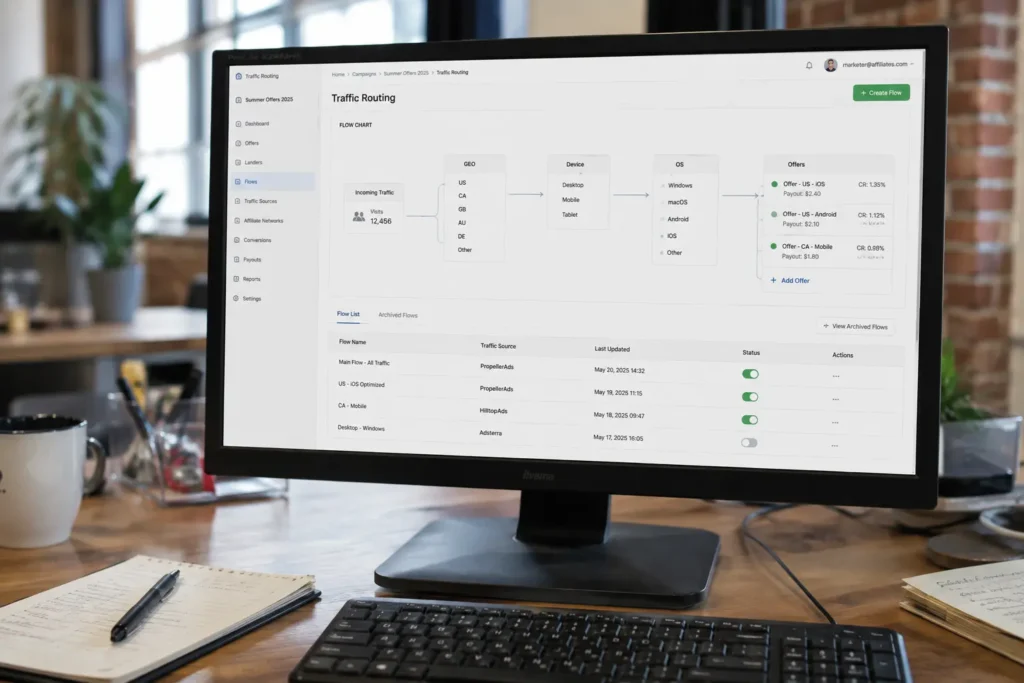
Smartlinks automate some stages of the offer selection process. Rather than diverting all visitors to a single campaign, traffic parameters are analyzed, and every visit is redirected to an appropriate offer.
The elements that can be taken into account when configuring Smartlinks include, but are not limited to:
- user’s GEO;
- type of device;
- operating system;
- traffic parameters;
- current campaigns and their performance.
Adverten implements its proprietary Smartlink infrastructure in order to facilitate traffic processing and monetization by seasoned affiliates. Together with traffic and campaign tracking, this provides publishers with an opportunity to reduce the manual offer selection process.
Why Affiliate Networks Remain Important in Performance Marketing
How do affiliate networks work in modern performance marketing? They combine three key aspects of the process – connection, technology, and operations – within a single infrastructure.
The functions of affiliate networks include:
- Connection: connecting advertisers to publishers and allowing publishers to find relevant offers;
- Technology: assisting in tracking, attribution, postback, reporting, and performance optimization;
- Operations: handling offer management, commission payments, payouts, campaign settings, and relations with both sides.
The significance of this infrastructure becomes particularly evident for publishers managing large traffic volumes, GEOs, or different kinds of campaigns. Working with multiple advertisers requires multiple accounts, tracking integration, reporting solutions, payment terms, and campaign management. Affiliate networks manage all of these aspects in a single infrastructure.
A Smartlink-based CPA network can become another step in increasing efficiency for experienced publishers. Instead of manually routing traffic to a particular campaign, Smartlink technology analyzes traffic properties and redirects users to available offers.
Adverten combines this concept with its own Smartlink technology and real-time tracking and campaign monitoring.
FAQ: Affiliate Networks for Advertisers and Publishers
How does one become a verified publisher within an affiliate network?
Verification depends on a variety of factors, such as traffic sources, GEOs, experience, and promotion methods. When trying to understand how do affiliate networks work for a publisher, verification is a key component to obtaining campaigns that fit his/her needs.
What do affiliate networks do if a cap or offer limit is in place?
Advertisers can set daily or total conversion limits. Part of comprehending what does an affiliate network do involves understanding how campaigns are capped, paused, and offered alternatives.
What happens when an affiliate offer becomes unavailable?
Publishers might be required to reroute their traffic should an offer be paused or withdrawn. Smartlink technology can help automate this process and direct potential clients to other campaigns.
How do the affiliate networks handle invalid conversions?
Affiliate networks can refuse duplicated, fraudulent, banned, or other ineligible actions. Good conversion tracking for affiliates will help you identify valid conversions and maintain accurate campaign statistics.
When do affiliates get their payments from the publishers?
Payout schedules depend on the network and conversion approval processes. Affiliate conversion tracking is essential to ensure actions are properly attributed for commission payments. Adverten provides its approved partners with weekly payouts.
What is an affiliate network that experienced publishers should look for?
Some critical elements include offer relevance, GEO coverage, payments, reliable tracking, reports, customer service, and monetization tools. Adverten includes all of them and adds its unique Smartlink technology for experienced affiliates.