

Dating affiliate campaigns may use very different creative formats for the same offer: images, banners, native placements, UGC-style video clips, short videos, carousels, and light animations. The creative format dictates what placements the ads can take, what information they can convey, how flexible adaptation is, and whether they work well with the traffic sources.
No single format works best for all campaigns. While a vertical video can easily fit into a mobile social media placement, it would be inappropriate for a small display placement. Banner formats can easily adapt to publishers’ inventories but often don’t have enough space to convey a message.
What works best for dating affiliates is a creative format that matches their traffic source, GEO, device mix, audience intent, offer requirements, funnels, and available creation resources. Our recommendations regarding dating affiliates at Adverten also follow the same rule.
TL;DR
- For scenarios where speed, scale, and coverage are key elements, static creatives or banner ads are recommended.
- Use native ads for content discovery scenarios.
- If the traffic is social and mobile-first, then either UGC-style creatives or short-form videos will work better.
- If you need more than one card or visual state to communicate the message, use carousels or animation.
- Always compare creatives across similar GEOs, devices, traffic sources, offers, and time periods.
- Measure conversions, conversion rate, EPC/EPM, ROI, and CTR.
Table of Contents
- How the Best Dating Ad Creative Formats Compare
- Static Image and Banner Creatives
- Native Dating Ads
- UGC and Short-Form Video Dating Creatives
- Best Dating Creative Formats by Traffic Source, GEO, and Device
- Best Dating Creative Formats by Campaign Goal and Funnel
- What Performance Data Says About Dating Creative Formats
- Expert Criteria and Common Mistakes When Comparing Dating Ad Formats
- Conclusion
- FAQ About Dating Ad Creative Formats
Introduction
Beyond the click, a dating creative sets expectations for the offer and the post-click process. If the ad, landing page experience, and target market match well, campaign data will be easier to analyze. But if not, a high CTR may mask low-quality conversions.
Format is just one piece of the puzzle for the campaign. Affiliates need appropriate traffic, acceptable promotion methods, accurate tracking, and an offer or monetization system that matches the audience. This is even more critical for multi-GEO and multi-device traffic campaigns.
For Adverten, its Smartlink CPA network is built on traffic processing and monetization. Creative gets people to click; then the offer or Smartlink decides how to monetize that eligible traffic.
How the Best Dating Ad Creative Formats Compare
Let’s start with where the ad will be displayed. Consider what users expect to see there, how much space or time it has, how much flexibility the format allows, and whether it adds extra production work. Next, consider the format’s performance. It can attract attention but have poor approval rates, EPC, EPM, or ROI.
| Format | Best Use Case | Traffic Fit | Production Effort | Scalability | Main Limitation |
| Static image | Fast deployment | Social, native, display | Low | High | Limited storytelling |
| Banner | Standard display inventory | Display, publishers | Low to medium | High | Banner blindness |
| Native | Content-led environments | Native, editorial | Low to medium | High | Click quality can vary |
| UGC-style video | Social-feed context | Social, mobile-first | Medium | Medium | Refresh and disclosure demands |
| Short-form video | Visual storytelling | Social, video | Medium to high | Medium | Production effort |
| Carousel | Several messages | Social, some display | Medium | Medium | More assets to coordinate |
| Animated/GIF | Lightweight motion | Display, some native | Medium | Medium | Uneven placement support |
| Text-led | Direct proposition | Native, email, text-heavy placements | Low | High | Less visual differentiation |
What Makes One Creative Format Better Than Another?
A creative format’s value increases when its advantages align with specific affiliate marketing campaign requirements. The best format may not be the most visually complicated or costly one. It needs to convey the offer clearly, fit the chosen ad placements, support a smooth conversion process, and be easily testable with target audiences.
There are several factors to consider:
- Traffic source: the format needs to match the context of the medium.
- GEO: language, cultural, and legal issues may influence feasibility.
- Device: smaller screens require a simpler format.
- Intention: low- and high-intention traffic behaves differently.
- Placement: feed, sidebar, recommendations, and video formats come with inherent restrictions.
- Step in the funnel: low-complexity and high-complexity steps require explanation.
- Production cost: the complexity of the format correlates with the production cost.
- Scalability: some formats scale and localize more easily.
Statements on the format being “best for” this or that case should always be conditional, until proven otherwise by comparative campaign data. Affiliate marketers should focus on formats matching their traffic context, and prove their adequacy with conversion quality, cost, and revenue.
Creative Format vs Creative Angle
The format is the structure; the angle is the message inside.
- UGC video is a format.
- A static banner is a format.
- Native image and headline are a format.
- “Meet people nearby” is a message angle.
- Positioning on relationships is an angle.
There can be a number of reasons why a single UGC video performs better than a single banner. Distinguishing between these aspects will help make meaningful comparisons.
Compliance applies to both as well. Switching the format does not validate the unsubstantiated claim. According to the Federal Trade Commission’s advertising guidance, advertising claims must be truthful, non-deceptive, and substantiated.
Examples of Dating Ad Creative Formats
Affiliate campaigns in the dating niche can take a variety of creative formats based on traffic sources, available placements, and how much information the ad needs to convey. Each format has its unique advantages for showing off the offer, getting users’ attention, and preparing them for further actions.
Typical dating offers can take one of the following forms:
- Static image in the style of a dating profile with the call to action;
- Static or responsive dating banner;
- Native ad featuring the image, headline, and description;
- Vertical UGC-style video;
- Produced video ad;
- Carousel with multiple cards;
- Lightweight animated display;
- Text-only ad, where most of the message is delivered through the headline.
The goal is not to compare simpler and more complicated creative formats here. It is all about choosing the format that includes sufficient information needed for a particular placement. Affiliates can even try out several formats for the same offer when the campaign conditions are similar and see how additional visuals and messaging affect conversion.
Why CTR Alone Does Not Define the Best Format
CTR measures how often an impression leads to a click. However, there are other metrics affiliates have to consider too, including:
- Conversion rate
- Approved conversions
- Approval rate
- EPC
- EPM or revenue per visit
- Rejection rate or refunds where applicable
- Cost of traffic
- ROI
- Results by GEO, device, traffic source, and placement.
Smartlink performance guidance from Adverten is consistent: focus on segmented performance, not just a single metric.
A creative with low CTR may be more profitable if it drives completion of a required action.
Other Formats: Carousel, Animation, and Text-Led Ads
Not all campaigns have to limit themselves to picking only between static, native, and video. There are other forms of affiliate marketing creatives that serve certain needs:
- Carousel: when multiple aspects require individual cards.
- Animated/GIF: when motion is required but the video solution seems too resource-consuming.
- Text-based creative: when the idea behind the product outweighs the visual and the placement has many text elements.
The formats mentioned above are most useful for solving certain communication problems. Additional cards, motion, or text should not complicate the communication process; they should add detail. If one card is enough to describe the concept, then the static format is more efficient.
Static Image and Banner Creatives

Static creatives are easy to handle. You can sometimes adapt the concept through aspect ratio, placement, and language variations without a full rebuild. This makes static creatives a good choice for multi-GEO campaigns and fast refresh schedules.
However, responsive environments cannot be taken lightly. Assets may be cropped and rendered differently; therefore, one composition may not necessarily fit all. Examples of responsive display formats show how horizontal, square, and vertical assets can work in various environments.
Static Image Creatives
The benefits of static creatives include:
- ease of production;
- speedy iterations;
- resizing ease;
- easy language translation;
- rapid refreshing;
- early comparison.
Static creatives work best when the concept is self-explanatory. Static creatives are not optimal when users need time to understand the sequence or an explanation before taking action.
In terms of readability, the W3C guidelines on text contrast are accessibility guidelines, not advertisement performance guidelines. However, the main concept is that text must have sufficient contrast in order to be readable.
Dating Banner Ads
Banner ads for dating sites are meant for well-defined display inventory. Environments commonly include:
- display placements on websites;
- banners on mobile devices;
- desktop sidebars;
- responsive display inventory;
- networks of publishers;
- retargeting placements, when allowed.
Banner work is partly technical – resizing and cropping may completely alter the composition. Official guidelines on standard display sizes will explain why desktop and mobile banners must not be considered similar.
Good dating banner ads often deliver a single message and do not attempt to duplicate the entire landing page within the ad.
Where Static and Banner Formats Fit in a Campaign
They work best for:
- high-variation creatives;
- various placements in terms of size;
- multiple GEOs;
- low production;
- frequent refreshing;
- high proportion of display traffic; and
- simpler propositions.
They are also useful as starting-point formats before moving ahead with richer formats in the same campaign.
Static/banner becomes less relevant if the proposition needs a sequence, voice, or further explanation. In that case, it’s better to use a format with higher communication bandwidth than to keep adding text to a static format.
Main Limitations
The creation of static creatives and banners is quite easy to do and deliver, but sometimes, that very ease turns into a problem when additional explanation of the message or some differentiation is needed from the creative. The performance of these creatives depends greatly upon the placement visibility, high-quality image used, and the comprehensibility of the core message in different screen sizes.
Problems often occurring with static creatives include the following:
- creative fatigue;
- banner blindness;
- lack of storytelling capabilities;
- dependency on one image/headline;
- limitation in image size/cropping;
- too many words used.
All those problems don’t make static creatives irrelevant; they just show cases when another creative format would work better. For instance, when you need to deliver a step-by-step offer, you can use a video, while the native ad would give you better contextual relevance.
Native Dating Ads
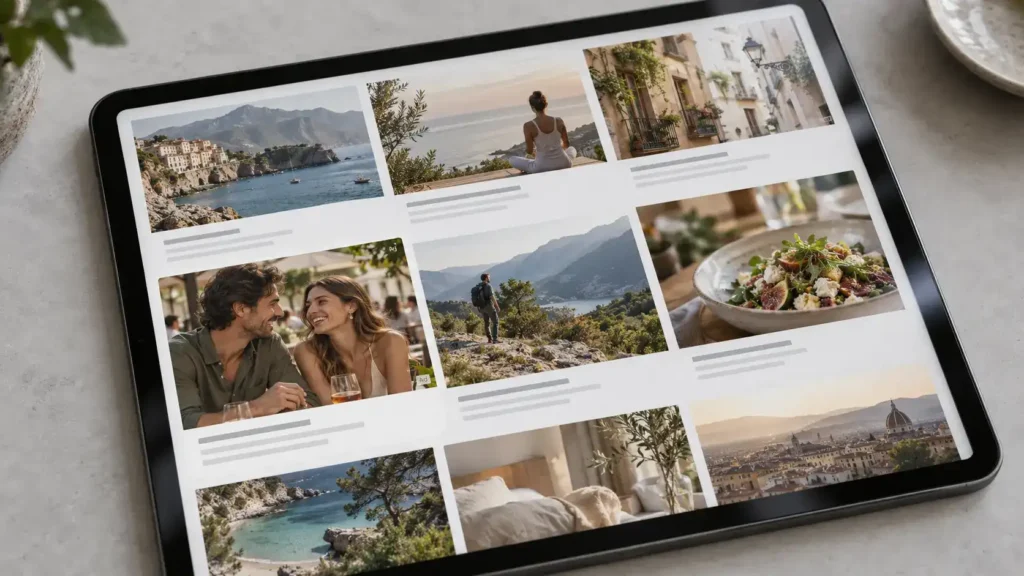
Native also brings up the issue of transparency. Native units may look similar to other content, minimizing visual interference but increasing the need for clear identification and consistent messaging.
FTC guidelines for native advertising require that advertisements not lead consumers to believe the content is independent or noncommercial. Therefore, you need to measure performance alongside transparency and conversion rate.
What Makes Native Dating Ads Different?
Common native ads include:
- image/headline combinations;
- content-style delivery;
- editorial placements;
- recommendation widgets;
- in-feed delivery;
- prelander funnels.
The key advantage of native ads lies in context. The disadvantage is that a curiosity click doesn’t necessarily indicate the user’s dating intentions.
The ad, its name, headline, picture, and destination must be coherent. If ambiguity about the ad’s commercial purpose or offer drives the click, the format will bring poor-quality traffic despite a decent CTR.
Where Native Creatives Fit Best
Native does well in:
- content discovery sites;
- editorials;
- recommender widgets;
- prelander funnel sequences;
- mobile browsing;
- where the headline carries much of the campaign message.
Localizing native ads is relatively straightforward, but it goes beyond translation. Context and user expectations can differ by market.
Dating native ads can provide a smoother transition from the ad to the landing page in content-led funnels.
Strengths and Limitations of Native Ads
Native dating ads merge together visual components and headlines in content-driven ad placements. The major advantage of such ads is the opportunity to blend into the content context without any sophisticated creative development. At the same time, context-based integration means message accuracy and clarity are crucial, especially when users see both ads and content-based recommendations.
Strengths:
- relevance of the context;
- flexible combination of visual components and headlines;
- rather quick adaptation;
- opportunity to use content funnels;
- simplified production process.
Weaknesses:
- the quality of clicks may vary;
- headlines influence performance;
- discrepancy of message and landing page is costly;
- disclosures really do matter;
- different publishers’ specifications.
Context is crucial for native ads, but it doesn’t automatically mean better CTR. When native ads receive high engagement from users, affiliates need to analyze whether users proceed to the landing page and perform some actions.
UGC and Short-Form Video Dating Creatives

Videos offer many more moving elements: opening sequence, pace, captions, voice-over, framing, length, and aspect ratio. This helps when the message is better delivered sequentially, but it complicates analysis when each rendition changes multiple elements at once.
Moreover, digital video spans many platforms and technologies. The IAB Tech Lab’s VAST standard exemplifies this need for standardized video delivery.
UGC-Style Dating Creatives
UGC-style creatives utilize the language of regular social content visually. Such formats include:
- testimonial-like video footage;
- video delivered directly to camera;
- first-person stories;
- content highlighting app usage experience; and
- social feed-type content.
The value lies in how the post fits in the feed, not how the ad looks on its own. When an endorser’s experience is highlighted, then the FTC Endorsement Guidelines apply.
Short-Form Video Creatives
A short video can be creator-driven, highly produced, animated, screen-driven, or consist of multiple shots.
It is good for:
- motion;
- sequence of information;
- demonstration;
- text, voice, and images in one package;
- versatility in vertical or square placements.
Video’s primary expense is production. Each new GEO will need fresh captions, voiceover, text on-screen, or possibly new video. Consider video primarily when the information can be conveyed through motion or sequence that cannot be effectively conveyed statically.
UGC vs Short-Form Video
| Factor | UGC-Style Video | Short-Form Video |
| Feel | Conversational, creator-like | Can be polished, scripted, animated, or creator-led |
| Production | Often lighter | Can be more complex |
| Structure | Personal or direct | Flexible and sequence-driven |
| Localization | May require reshooting | Can sometimes be modular |
| Main risk | Fake-authenticity or endorsement issues | High cost without better conversion quality |
Go for UGC when a humanized, conversational tone suits the surroundings. Choose a wide range of short video content if you want to control the story’s visual elements.
Main Limitations of Video Formats
UGC style and short-form video creatives provide greater possibilities for storytelling; however, they add new production and testing challenges. In contrast to static ads, video performance can be impacted by factors like pacing, opening scenes, sound, subtitles, and editing. These factors can make it harder to determine which creative elements drive campaign performance.
Common challenges:
- production costs;
- long iteration cycle;
- localization;
- dependence on the first few seconds;
- moderation challenges;
- “sound-on” and “sound-off”;
- creative fatigue on specific placements quickly.
The challenge is whether all this effort will be justified beyond the click-through rate. Affiliates need to compare video formats with simpler versions based on approved conversions, EPC/EPM, and ROI. Testing various videos by changing just one variable may help to spot differences in performance.
Best Dating Creative Formats by Traffic Source, GEO, and Device

Here, the task is just to narrow down the list of creative formats based on the environment. In dating app advertising, the same creative formats can perform very differently across mobile feeds, native ads, and publisher placements. Don’t force an affiliate ad into an environment it wasn’t designed for.
Adverten’s Smartlink advice also highlights segmentation by performance, GEO, device, placement, and audience.
| Traffic Environment | Formats to Prioritize | Why | Main Risk |
| Social/mobile feed | UGC, short video, carousel, static | Fits feed behavior | High refresh demand |
| Native/content | Native, text-led | Matches browsing context | Curiosity clicks |
| Display/publisher | Banner, static, animated | Fits standard inventory | Banner blindness |
| Mixed placements | Responsive/static asset sets | Flexible delivery | Less control over rendering |
| Desktop-heavy | Banner, static, native | More horizontal space | Weak mobile reuse |
| Mobile-heavy | Vertical/square video, native, mobile static | Better screen fit | Small text and overload |
Social and Mobile-First Traffic
The shortlist typically contains:
- UGC-like video;
- vertical short-form video;
- carousel;
- static square/vertical;
- feed-style native ads.
Opt for static if the concept is simple and speed matters. Opt for video/carousel if the sequence adds value to the viewer’s comprehension.
The Ofcom Online Nation study monitors online activity across devices and platforms, reminding us why digital consumers shouldn’t be treated as one cohesive entity.
Native Traffic
Native advertisements typically use image-and-headline or text-led formats. Rich formats are to be considered only if the publisher and message support this type of format.
If native ad units get strong click-through but low approved conversions, the issue is message qualification.
The best native format combines contextual relevance, transparency, and consistent content across the destination.
Display and Publisher Traffic
Common dating display formats include:
- a fixed banner;
- a static image;
- a responsive asset;
- and light animation.
Different aspect ratios can affect cropping and text readability. Official ad format specifications explain why asset sets require several aspect ratios.
Select a format that will keep the essence of your message in all placements you actually purchase.
Mobile vs Desktop
Mobile design should include:
- a single focus;
- concise text;
- vertical or square designs where possible;
- quick-loading resources;
- action prompts;
- mobile-optimized landing pages.
Desktop design offers more room but not necessarily more text. Separate results by device so that any strong device-specific performance trend does not get diluted in overall campaign statistics.
GEO Differences in Creative Format Selection
Verify:
- language;
- dominant traffic sources;
- devices;
- expectations of local users;
- restrictions of advertisers;
- platform guidelines;
- advertising and privacy laws.
If you use EU traffic, the Digital Services Act obligates you to provide transparency for your advertisements and limits targeting practices, including targeted ads based on sensitive personal data categories. Therefore, you should consider GEO as part of the overall campaign context for dating campaigns.
Best Dating Creative Formats by Campaign Goal and Funnel
A campaign designed to test a proposition differs from one aimed at a proven audience or a higher-commitment funnel. According to Adverten’s guide on dating programs, the marketing funnels for SOI, DOI, CPL, and CPA require different levels of user commitment.
The marketing campaign format must create proper expectations from the beginning.
| Campaign Goal or Funnel | Formats to Prioritize | Why | Key Metric |
| Fast validation | Static, banner, basic native | Quick to produce | CTR plus conversion rate |
| Engagement-focused social | UGC, video, carousel | Supports sequence | Qualified conversions |
| Simple registration | Static, native, short video | Concise message is enough | Approved registration rate |
| Higher-commitment flow | Video, carousel, richer native | More room for context | Approval rate, EPC/EPM, ROI |
| Multi-GEO rollout | Static, native, modular video | Easier adaptation | Performance by GEO |
Best Formats for Fast Campaign Validation
Prioritize:
- statics;
- banners;
- basic native units;
- animation.
These ads are simple and fast to develop, letting you focus on one concept at a time. Rapid validation doesn’t mean scaling with a couple of clicks; the campaign must generate enough traffic and conversions to support decision-making.
Best Formats for Engagement-Focused Campaigns
Good choices would include:
- UGC video;
- short-form video;
- carousel;
- richer native creative.
This is because such creatives give more opportunity for movement and sequencing. Engagement is still only an intermediate metric rather than the end goal of business. A creative can generate high view-through rates and clicks but still produce low-quality conversions, which may indicate curiosity rather than strong intent.
Best Formats for Simple Conversion Flows
In general, simple conversion funnels will work better with creatives that clearly convey the offer and make the next move clear. If all the user needs to do is a simple registration or other simple task, additional storytelling will not help to make it clearer. The key here is to have an appropriate creative to correspond with the destination and conversion to make.
The following can serve as a simple flow:
- static image;
- native image and headline;
- a concise banner;
- or a short video in a video-first format.
No unnecessary explanations of the move the user has to make, alignment with the landing page, and no claims that the funnel cannot fulfill. In simple conversion funnels, it makes sense to test if a concise creative brings in users that take the needed action, rather than just engage. An elaborate format can be justified if it helps to convert better or makes the campaign more profitable.
Best Formats for Longer or Higher-Commitment Funnels
A longer conversion funnel in dating requires that users understand further actions to achieve the desired action. In such instances, creatives that have higher communicative ability may be used to set up expectations and make the proposition clear to users. More content becomes useful when it adds information that the user needs before he/she can proceed any further.
Some higher-commitment funnels might be improved by using the following forms:
- Short-form video;
- Explainer UGC;
- Carousel;
- Native creatives linked from a prelander; and
- Text-based qualification.
More complex forms may help when they increase comprehension before users click through. Richer forms won’t improve conversion quality if they don’t increase comprehension. For example, the carousel may break down important information into different cards, and a short video may illustrate a series of actions.
What Performance Data Says About Dating Creative Formats
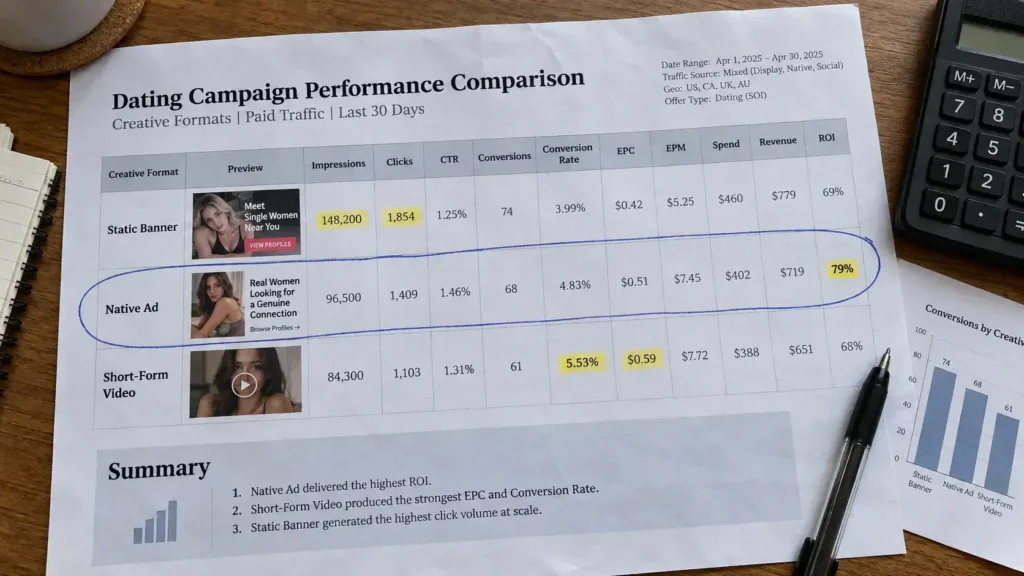
Industry statistics are helpful; however, they should not be treated as a universal standard. In practice, statistics for each segment are more relevant.
Adverten has not published a standardized comparison of dating creative formats with fixed sample sizes and performance data. For this reason, creative formats are better compared using actual campaign data
Industry Statistics and Advertising Trends
According to the IAB/PwC 2025 Internet Advertising Revenue Report, internet advertising revenue for the United States stood at $294.6 billion in 2025, an increase of 13.9% from the previous year. Digital video experienced an increase of 25.4%, whereas display advertising, which includes banners, rich media, sponsorship, and native, stood at $81.6 billion.
According to IAB’s 2025 Digital Video Ad Spend report, digital video ad spend in the US in 2024 stood at $64 billion, and it was expected to reach $72 billion in 2025.
According to the Pew Research Center, about one-third of US adults have used a dating site or app.
These numbers give some perspective, but they don’t tell us which format is the most successful.
| Verified Statistic | What It Means |
| U.S. internet ad revenue reached $294.6B in 2025 | Digital advertising remains a large multi-format market |
| Digital video revenue grew 25.4% YoY in 2025 | Video is expanding quickly, but growth isn’t campaign-level proof |
| Display revenue reached $81.6B in 2025 | Banner, native, and rich-media formats remain material |
| U.S. digital video spend was $64B in 2024 | Video attracts significant advertiser investment |
| 30% of U.S. adults had used online dating in Pew’s 2022 survey | Dating reaches a broad audience with many segments |
Adverten Performance Metrics for Creative Evaluation
Clicks, conversions, conversion rates, EPM, postbacks, sub-IDs, GEOs, and devices are defined in the CPA publisher guide provided by Adverten. This information will allow affiliates to see how their traffic behaves after the user clicks the ad. Creatives should therefore be evaluated not only by clicks but also by the results of monetizing traffic with different creative types.
Some metrics that may be helpful include:
- clicks;
- CTR;
- conversion rate;
- approval rate;
- EPC/EPM;
- cost;
- ROI.
All the above-mentioned metrics should be compared with regard to the different creatives. Split the data by GEO, device, traffic source, placement, and offer wherever possible to draw fair conclusions about relative creative performance under similar conditions.
Adverten’s Performance Evaluation Framework
Adverten evaluates traffic performance by GEO, device, placement, campaign, audience segment, and key performance metrics, without assuming one creative is superior to another.
Key evaluation dimensions include:
- GEO;
- Device;
- Placement;
- Campaign;
- Audience segment;
- EPM/Revenue Per Visit;
- Conversion Rate;
- Clicks/conversions;
- Revenue performance.
Similarly, poor-performing segments may require different creatives, prelanders, and other tools. Therefore, “video beats static” is not a valid claim unless the traffic is comparable and the analysis is based on conversions.
Adverten’s method for evaluating traffic and offers is the same.
What the Data Does and Does Not Prove
Data will reveal:
- the better-performing format in a certain campaign;
- if performance differs based on device or GEO;
- if high CTR translates to conversions; and
- if high production value is worth the expense.
It cannot, however, conclusively say whether a similar format will succeed in a different GEO, source, offer, or season.
Quality of traffic, sample size, available offers, and landing page experience are just a few factors that could influence performance.
Expert Criteria and Common Mistakes When Comparing Dating Ad Formats
Disciplined comparisons beat chasing the latest format. Just because something is current doesn’t make it better, and just because something is familiar doesn’t mean it is weak.
Compliance is an aspect of performance. Campaigns must also account for FTC truth-in-advertising principles in the U.S., as well as DSA transparency and targeting regulations for EU traffic.
Expert Tip: Start With Format Fit, Not Format Popularity
Questions:
- Where will the ad be placed?
- Is it a feed, editorial, display, email, or video environment?
- What is the main device?
- How much information is required before clicking?
- What formats does the media support?
- How often do you have to refresh your creative?
- Does the format require localization or moderation?
Exclude formats that aren’t suitable for the environment.
Mistake: Choosing the Winner by CTR Alone
Tracking:
- CTR;
- Conversion rate;
- Approved conversions;
- Approval rate;
- EPC or EPM;
- Media cost;
- Rejections/refund trends, if applicable;
- ROI.
As Adverten’s article on Smartlinks vs. direct offers suggests, analyze EPC and EPM instead of focusing on payout. Use the same multi-metric approach for creative analysis.
Mistake: Comparing Different Campaign Conditions
Don’t make generalizations based on the fact that creatives found their way to:
- different GEOs;
- different sources;
- different offers;
- different devices;
- different audiences;
- different placements;
- completely different times.
Mobile social video and desktop publisher banner cannot be considered a control test. Segment by source, GEO, device, placement, and offer where possible.
Expert Tip: Account for Production and Refresh Costs
Comparison:
- cost of production at the starting point;
- time taken to edit;
- aspect ratio needed;
- amount of work needed to localize;
- reshoot or voiceover required;
- time taken to moderate;
- creative lifecycle;
- refresh frequency.
A more expensive format can be justified if it improves approved conversion performance. An inexpensive format can still be inefficient if it requires frequent refreshes or performs poorly.
Expert Tip: Connect Creative Performance With Offer Monetization
The creative generates the click; the click leads to the landing page or prelander; qualified traffic reaches the offer or Smartlink; conversions generate revenue.
The Adverten Smartlink works at the traffic processing and monetization level. It doesn’t turn bad creative into good creative. Affiliates need to analyze the creative along with offer, GEO, device, and source data.
Choosing the Best Dating Ad Creative Format for Your Campaign
Remember that the best ad type depends on how you plan to promote your dating ads and how you want to track traffic.
Static images and banners tend to scale better across display placements, while native formats perform better in content-heavy placements. Meanwhile, UGC and video formats make more sense for social media traffic.
If you want to compare formats, keep the same GEOs, devices, sources, offers, and timeframe.
CTR matters, but you should also consider conversion rate, approval rate, EPC, EPM, cost, and ROI.
If you already use dating traffic, Adverten has a guide on Smartlinks and direct offers with more information on monetization strategies. You can also explore the Adverten platform itself.
FAQ About Dating Ad Creative Formats
What is the best creative format for dating ads for affiliate marketing?
There is no one-size-fits-all best format. You can use static banners for display advertising, native ads for content-led placements, and UGC/short video for social/mobile traffic. It all depends on the ad creative formats, traffic source, funnel, geography, and performance of the campaign. You have to compare different ad formats under similar conditions.
Are video dating ads better than static creatives?
It is not always so. Video provides more opportunities for motion and story, while static creatives are easier to create, size, and adapt to various local markets. Video ads may be justified only if they provide better conversion or make the campaigns more profitable.
Which dating ad format is easiest to scale?
Among all ad formats, static images and dating banner ads tend to be the easiest to scale because they adapt easily to different sizes. Native ads also scale well across compatible placements. Scalability ultimately depends on factors such as inventory, GEO, traffic quality, and conversions.
Which dating ad formats work best for mobile traffic?
Vertical video, user-generated content (UGC) creatives, carousels, square/vertical static, and native feed ads are some of the formats that work best on mobile traffic. This is especially true for dating app advertising.
Could dating native ads be used in an affiliate campaign?
Yes, dating native ads can work well in content discovery, editorial, and recommendation environments. The ad should be recognizable as such and aligned with the offer or landing page. Use conversion quality, not just clicks, to measure native traffic.
Is the same creative applicable across GEOs?
Yes, but creative adaptation may still be necessary, depending on language, audience, device usage patterns, traffic sources, advertiser requirements, and local legislation. You need to analyze creative performance in each GEO separately.
Should dating creatives be judged based on CTR or conversion?
Both are important factors, but conversions matter more. CTR tells you whether your creative attracts clicks, but conversion rate, approval rate, EPC/EPM, and ROI tell you how valuable those clicks were. This becomes even more important for comparing affiliate marketing creatives between traffic sources.
Are Adverten Smartlinks compatible with different formats of advertising creatives?
Yes. Affiliates can use different compliant creative formats to drive traffic, after which eligible users may be sent to an offer or Adverten Smartlink. The creative format is separate from the traffic processing and monetization layer.
How often must dating ad creatives be updated?
Not all campaigns need to be updated at a certain frequency. Update your creatives when you notice they are underperforming, the audience has seen them too often, or there are changes in the GEO, placement, or traffic sources for your campaign.
Will a more expensive creative format perform better?
No. Creative production cost has no direct link to performance. An inexpensive static or native ad might perform much better than an expensive video if it communicates your offer effectively and drives higher conversions, EPC/EPM, and ROI. Adverten recommends looking at campaign performance rather than production cost alone.