

A prelander is the page a visitor sees between an advertisement or publisher placement and the final affiliate offer. It can explain the offer, help people decide whether it suits them, or prepare them for the action expected on the advertiser’s website. For CPA affiliates, that extra step can be useful, but it also gives visitors another opportunity to leave. Choosing the right format matters more than simply inserting a page into every campaign.
The best prelander types for CPA and dating affiliate traffic include quizzes, advertorials, comparison pages, story-based pages, and simple bridge pages. Each format serves a different intent. A dating prelander that asks a few relevant questions may help visitors clarify what they want. A short bridge page may make more sense when users already know what they are looking for.
Prelanders also need to fit the monetization flow. Adverten operates as a Smartlink CPA network focused on traffic distribution and monetization. Its Smartlink technology can route eligible visitors toward relevant offers using traffic parameters and offer availability. A prelander can prepare the visit before that routing takes place, while tracking helps affiliates evaluate the whole journey rather than one attractive click metric.
TL;DR
- Quiz and survey prelanders can help dating visitors identify relevant interests when the questions add genuine value.
- Advertorial prelanders work as informational introductions when a visitor needs context before viewing an offer.
- Comparison and review-style prelanders help people weigh real differences, provided claims and ratings are accurate.
- Story-based prelanders connect an offer to a recognizable situation without inventing personal testimonials.
- Simple bridge prelanders offer a short path when audiences already understand the proposition.
- Smartlink-based flows can support offer matching, but the prelander still needs a clear purpose and reliable measurement.
Table of Contents
- Best Prelander Types for CPA and Dating Campaigns
- Best Prelanders for Different Affiliate Traffic Sources
- How Prelanders Work with Adverten Smartlinks
- Prelander Examples for CPA and Dating Affiliate Traffic
- Common Prelander Mistakes That Reduce CPA Performance
- Expert Tips for Choosing High-Converting Prelanders
- Prelander Conversion Statistics and Performance Metrics
- Case Study: Comparing Dating Prelander Formats
- Conclusion: Choosing the Best CPA Prelander
- Frequently Asked Questions About CPA and Dating Prelanders
Introduction
A well-designed prelander increases campaign efficiency by helping users get acquainted with the offer before they’re transferred to the advertiser’s page. The best prelanders focus on providing information about the next step rather than creating more clicks for their own sake. But adding a prelander to an ad campaign is not always the right answer.
Some users will need to take a quick dating quiz, while others will prefer reading short material and comparing offers and landing pages, among other things. Prelander types will differ, so choose a prelander that matches your traffic source and the actions you want users to take.
Prelanders can also use Adverten Smartlink technology, which analyzes incoming traffic and redirects visitors to relevant, available offers. A smartlink prelander flow combines an introductory page with that routing step.
In this article, you will learn more about the most popular types of prelanders and find out the best time to use them for CPA and dating affiliate campaigns.
Best Prelander Types for CPA and Dating Campaigns
A good affiliate marketing prelander provides unique value to the visitor. It may provide context for your dating site, the selection process, or what happens after they click. A prelander’s effectiveness isn’t defined by its length or complexity. Sometimes, a good one-screen introduction works better than a complex quiz, and vice versa.
For affiliate marketing, it is equally important to consider what comes right after the prelander. Great CTR means little if the user is surprised by the target landing page, doesn’t qualify for the offer, or can’t complete the advertiser’s action. Use the following comparison only as a guideline for testing. The best prelanders fit both the visitor and the advertiser’s requirements.
| Prelander type | How it works | Best for | Traffic sources worth testing | Main advantage | Main limitation |
|---|---|---|---|---|---|
| Quiz or survey | Asks relevant questions before the offer | Interactive dating qualification | Social, selected publisher placements | Engages users through a clear selection process | Extra questions increase abandonment risk |
| Advertorial | Explains a topic and connects it to an offer | Audiences seeking context | Native, content-led placements | Builds understanding before a decision | Can mislead if editorial independence is implied falsely |
| Comparison or review-style | Presents genuine criteria and differences | Visitors evaluating alternatives | Search, content, native | Helps users make a considered choice | Requires accurate, current information |
| Story-based | Explains a relatable situation and next step | Context-driven introductions | Social, native, owned content | Makes the use case understandable | Fabricated stories damage trust |
| Simple bridge | States the proposition and links onward | Visitors with clear intent | Push, search, email, owned traffic | Reduces unnecessary friction | May add no value when direct linking works better |
Quiz and Survey Prelanders for Dating Traffic
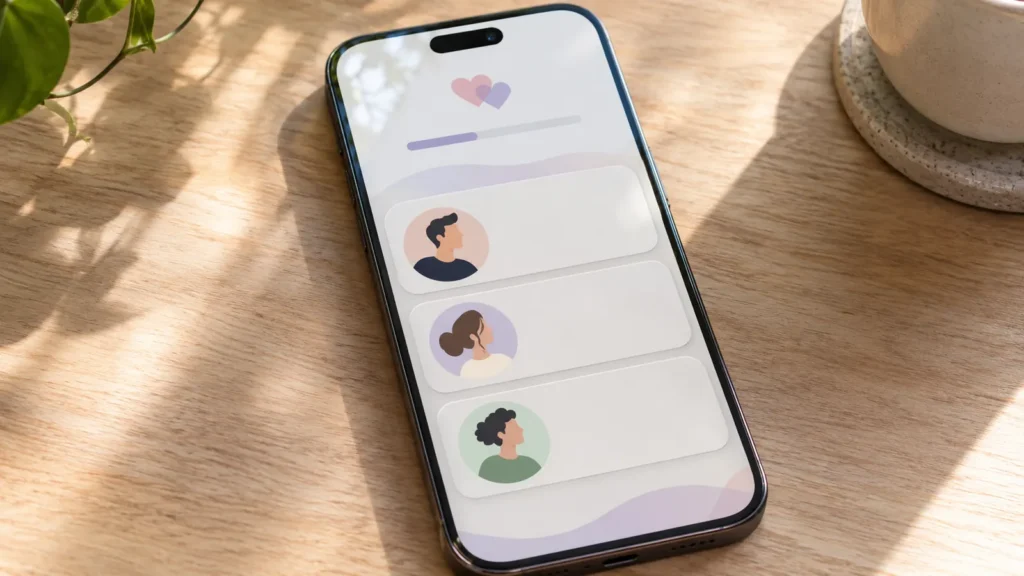
Quiz and survey prelanders ask visitors a couple of questions before redirecting them to a dating offer. This dating prelander format works best when the answers help visitors understand their options. For instance, someone who needs a dating service can choose casual dating or a more serious relationship. This makes the process more personalized and gives you a better sense of their needs.
To make an effective dating quiz:
- Ask questions briefly and directly. Only those questions that will help visitors make their choice should be asked.
- State the goal of the quiz. Explain why visitors have to answer questions.
- Make the quiz mobile. Use big buttons and answers that will be easy to tap on mobile devices.
- Inform visitors of the result. Tell them where they will be redirected after filling out the quiz.
- Don’t be deceitful. Do not show irrelevant matches, messages, or profiles to motivate clicks.
- Do not violate privacy. Use personal data only when needed.
Pre-landing quizzes suit those who are still considering their dating options. However, asking too many questions will bore visitors and cause them to leave the site without reaching the offer.
W3C labeling form controls guidelines explain how to write questions and answers.
Best for: Dating campaigns where an interactive quiz helps visitors get acquainted with different dating offers.
Advertorial Prelanders for CPA Affiliate Offers

An advertorial is an information-packed web page that combines customer-benefiting content with commercial follow-up actions. Among prelander types, it suits visitors seeking context. For CPA prelanders, you can include tips on choosing an online dating agency, registration details, or frequently asked questions.
The main components of a successful advertorial include:
- A relevant title corresponding to the advertisement’s offer.
- Some description of the visitor’s problem or desire.
- Facts presented accurately and recommendations clearly highlighted.
- Description of the nature of the service offered.
- Disclosure, if necessary, to establish the nature of the commercial relationship.
- A proper CTA that implies no guarantees.
This format is particularly useful to test after native advertising or content from information publishers. Nevertheless, advertorials should never pass as journalism. This is why the FTC’s guidelines on native advertising emphasize recognizing the commercial nature of ads and ensuring disclosures are clear and conspicuous.
Best for: Visitors who need an explanation before evaluating an affiliate offer.
Comparison and Review-Style Prelanders
Comparison pages enable users to choose between real choices. Instead of claiming one dating website suits everyone, they present key criteria such as service type, requirements, registration, platform availability, geographical availability, or any other verifiable factor. A comparison page can still be helpful even if it presents service types rather than specific services.
A trustworthy comparison page must:
- Specify which criteria are important and provide the explanation.
- Apply the same criteria to all options presented.
- Distinguish between facts and editorial recommendations.
- Point out limitations and trade-offs as well as benefits.
- Refrain from inventing star ratings, made-up numbers of users, false reviews or unreliable rankings.
- Reveal affiliations if necessary.
When a review or recommendation may be affected by payment received, then the endorsement guide of the Federal Trade Commission applies. Generally speaking, a comparison prelander will perform better if the reader needs to make a real decision. With only one offer, it may be better to describe it without creating the illusion of comparison.
Best for: People with specific interests interested in alternatives before proceeding.
Story-Based Prelanders for Audience Engagement
In a storytelling prelander, you need to present a situation, explain why it matters, and suggest the next step. Dating stories can highlight the difficulty of choosing a website with clear communication and registration procedures. People need to relate to the situation easily, without inventing something artificial that creates emotional tension.
The story should have four components: situation, consideration of the situation by the user, possibilities, and the next step. The story should be consistent with the offer. If you deal with a landing page for dating registrations, there is no guarantee the user will find a certain match or result from the advertiser.
Fictional examples can be used in illustration, so long as they are explicitly stated as being fictional. Never pose fictitious examples as genuine customer reviews, private messages, authenticated accounts, or case studies. Ensure that the tale is short enough to aid the visitor in making his or her choice. A page that piques interest but fails to communicate the destination increases traffic and lowers conversion rates.
Best for: Visitors who need a relatable reason to consider the offer relevant.
Simple Bridge Prelanders for Direct Traffic Flows
A basic bridge prelander is a simple page that appears before the affiliate landing destination. This page provides users with enough information that will help them understand the offer and to determine whether they want to proceed or not. The basic bridge prelander consists of the headline, one or two paragraphs, and a CTA. This kind of prelander may also include basic qualification parameters such as audience and target country.
Those are examples of bridge-page elements that you might find helpful:
- Headline matching the ad or placement made by the publisher.
- Destination description using clear words.
- Disclosure of commercial purpose.
- One next step and not several competing buttons.
- Quick loading layout suitable for mobile devices.
- None of these elements should trick users in any way.
It is not necessary for a bridge to be better than the direct link to the offer itself. It becomes unnecessary if it merely duplicates information without making things clearer; deleting it could even increase friction. Compare the performance of a bridge with a direct link (which is permissible) on conversion rate, considering its cost.
Best for: An audience who needs an introduction but no education process.
Best Prelanders for Different Affiliate Traffic Sources
The initial traffic source is a simple way to observe how different expectations affect prelanders. Different affiliate traffic sources can bring visitors with very different levels of interest. Visitors who arrive via content recommendations may be looking for something to read; people who arrive at a dating site through search will be seeking something immediate. This suggests that the prelanders will work in one situation but not in another.
Before opting for a prelander, evaluate the ad itself, where it will be used, which device it will run on, how recognizable it is to the target audience, and the rules governing the offer. A good affiliate marketing prelander should match that context. Compatibility of your campaign and platform should also be confirmed. The prelanders are useful in helping you outline the direction of your campaign. Never let the prelanders hide anything from you and your reviewers regarding the final offer. All important information is available in Adverten affiliate marketing terms.
| Affiliate traffic source | Typical starting context | Prelander worth testing | Why it may fit | What to compare |
|---|---|---|---|---|
| Social media | Interest sparked by a creative | Quiz or short explanatory page | Adds context or a useful choice | Quiz completion, approved conversions |
| Native advertising | Content-oriented click | Advertorial or story | Matches an informational expectation | Content engagement, revenue per visitor |
| Push or pop | Brief attention window | Simple mobile bridge | Makes the destination clear quickly | Loading speed, offer conversion |
| Search | Often a specific question or goal | Comparison, bridge, or direct link | Matches the expressed intent | Approved conversions and cost per acquisition |
| Permission-based email | Previous message supplies context | Consistent bridge or direct offer | Keeps the promised path recognizable | Revenue per eligible visit |
| Publisher-owned website | Content relationship already exists | Contextual bridge or comparison | Extends the reader’s current topic | Qualified visits and conversion quality |
Social Media Traffic: Quiz and Interactive Prelanders
A person may reach one of these social venues without actively looking for a dating offer. A dating prelander can present the service without making it seem like a personal fit. In these cases, a prelander can inform users about the services offered in the ad. For this purpose, a quiz or testing function is recommended, but an easier way will do if your ad mentions the service.
When working on your social traffic, keep in mind:
- Message matching: the message of your landing page should be relevant to the message of your ad;
- Mobile readability: short copy, functional buttons, and CTA;
- Interaction relevance: no need to ask additional questions in order to make users interact with your landing page;
- Real user expectations: you can never say that there is a certain person waiting to talk to your users;
- Platform policies on dating offers, adult content, targeting, and destination pages.
If you provide data on the dating prelander about the service itself for users and not about a fictional character who will communicate with them, compare an interaction-oriented and a short non-interaction-oriented landing page.
Native Advertising: Advertorial and Story Prelanders
Native advertising always relates to the surrounding content. The best prelanders for these placements follow through on the topic that attracted the click. So, an article-style prelander can be the logical conclusion if it delivers the information promised by the creative. For instance, an ad about choosing an appropriate online dating experience can take users to a clear page with information on selection criteria.
Native advertising prelander should:
- Give the promised information without the misleading heading;
- Clearly show its commercial nature where it is necessary;
- Base its statements on facts and good examples;
- Not use fictitious interviews, publishing recommendations, and fake reviews;
- Reveal the next commercial step before the call-to-action.
The page can have either comparative tables or stories, but the commercial purpose should be absolutely clear. The objective is not to pretend it is editorial content, but to give users enough information to choose. Track whether visitors move further, complete the desired actions, and don’t just spend a lot of time on the page.
Push and Pop Traffic: Short and Mobile-First Prelanders
Generally, push and pop ads provide minimal information before visitors click. With these affiliate traffic sources, visitors often need a brief explanation rather than a long page. This is where a short prelander can help, as it provides the necessary information about the offer and sets expectations for the click experience. Only make sure to check if such prelanders can be used with the chosen traffic source and advertiser.
Key points include:
- Clear headline. Inform visitors about the offer without the need to scroll the whole page.
- Fast-loading page. Optimize pictures and do not overload your page.
- Mobile optimization. Use legible text and easily clickable buttons.
- Good navigation. Remove unnecessary elements and pressure tactics like false countdowns.
- Honest representation. The page you created must represent the offer correctly.
- Campaign compliance. Ensure that traffic source and prelander follow the advertiser’s policy.
Shorter prelanders may deserve trials as push/pop traffic because people will be able to access the offer after making fewer actions. Nevertheless, shorter does not always mean better, so experiment with different designs and focus on conversions rather than clicks.
Because traffic from these sources likely comes from mobile devices, pay special attention to page load speed and overall usability. You may use Google’s Core Web Vitals guidelines to find out about the problems.
Search, Email and Website Traffic: Choosing the Right Flow
Because traffic from search, email, and publisher websites likely provides more context than a cold impression, each prelander must be unique. Affiliate traffic sources must not be automatically sent through the same page. Someone looking for information about the differences between dating service groups will likely like something similar. A user who clicks through an email because of permission should get a consistent link to the destination.
Use the following decision factors:
- For search – satisfy the query, don’t distract people with a marketing interruption.
- For email – ensure that the destination aligns with the message and honor the permissions and opt-out obligations.
- For owned site traffic – tie the offer into the surrounding content and explain how they are related.
- If users already understand the offer, compare the benefits of a bridge to direct linking.
The UK Information Commissioner’s Office provides guidance on how to conduct direct marketing via email. In addition, requirements vary by circumstance and jurisdiction, and affiliates cannot ignore them just because they’re allowed to use email as a source.
More details about maximizing traffic monetization can be obtained through the Adverten Smartlinks resource.
How Prelanders Work with Adverten Smartlinks

Three elements should be defined as one funnel in order to achieve the goal set above. A smartlink prelander is one way to introduce the offer before the routing step. The first element is the qualification or interaction page – prelander. The second element is the traffic-processing tool, Smartlink, which decides which offer to send traffic to based on the available data. The third element is the advertiser’s page, where the system tracks conversions from the offered service.
According to the Adverten Company website, the main element and traffic-processing tool is the Smartlink, which decides based on GEO, device, OS, traffic data, available offer, and performance. A dating Smartlink can be relevant when eligible dating offers differ by location or device. Additionally, Adverten Company provides references to public documents on prelanding and funnel optimization capabilities. This is no guarantee that all of the answers to the quiz will be useful for the work of Smartlink.
| Component | Primary purpose | Information it uses | Visitor action | Main measures |
|---|---|---|---|---|
| Prelander | Explain, qualify, or guide | Creative message, audience needs, page content | Read, answer, or click | Engagement, completion, click-through |
| Adverten Smartlink | Distribute eligible traffic to offers | Supported traffic and offer signals | Continue to the selected offer | Routed clicks, offer-level performance |
| Advertiser landing page | Present the service and conversion process | Advertiser’s offer and eligibility conditions | Register, sign up, or take another qualifying action | Valid conversions, approvals, revenue |
From Affiliate Prelander to Smartlink Routing
Consider the conventional flow of the CPA campaign process:
- An authorized user clicks an authorized placement. A well-placed ad for the right service leads them to the right page.
- The prelander describes the offer. It provides additional information, asks necessary questions, or offers comparisons.
- The user makes the decision to proceed. A clearly shown CTA indicates that the visitor will move further either for dating or for another CPA offer.
- The Smartlink handles the visit. According to the configuration of the campaign, Adverten may use traffic characteristics and offer information to distribute traffic.
- The visitor lands on the page. The offer page describes the required registration or other necessary action.
- Result tracking occurs. Proper reporting and postbacks track clicks and authorized conversions for the campaign.
This is one possible scenario for using the smartlink prelander flow; however, it does not guarantee that every CPA campaign uses the same flow. In some cases, targeted CPA campaigns need more effective distribution through the offer’s direct link. Adverten’s Smartlink and prelander guide considers this problem.
Dating Smartlinks and Automated Offer Matching
A dating smartlink is especially useful for geo- or device-specific traffic, or when you have more than one offer. Instead of setting destinations manually for each user, the Smartlink evaluates traffic suitability based on platform signals.
The important things to consider are:
- GEO – the offer might work only for certain geos.
- Device and OS – there might be technical limitations for some LPs.
- Traffic source – different traffic sources might be allowed for different offers.
- Availability – the offer might be off, capped, or not available.
- Performance – think about the information you have about available campaigns.
Also, make sure the prelander shows the right course of action. You should not assure the user about his/her possibility of using a particular service if the destination cannot be set, because your routing configuration doesn’t provide that. While communicating with a wide audience, make general statements, e.g., “Visiting a good dating service.”
Tracking Prelander Performance with Adverten
Tracking the connection between the original source, the outgoing click, and the conversion is essential for accurate tracking. This matters for any affiliate marketing prelander, not only for a quiz. Otherwise, marketers risk confusing popularity with profitability. Adverten’s teaching materials cover the following aspects of the CPA campaign: campaign parameters, source-level analysis, postback, and conversion confirmation.
The tracking approach should be based on:
- Visits to the prelander and unique visitors to the prelander.
- Outgoing CTA clicks and prelander click-through rate.
- Visits to the offer/prelander click-through rate.
- Conversion and advertiser-confirmed conversion.
- Earnings per click and earnings per prelander visit.
- Budget spending, cost per acquisition, and ROI.
- Performance by source, GEO, device, placement, and sub-IDs.
Comply with naming convention standards. The Google Analytics URL guidelines example shows that UTMs support campaign attribution. Different networks use various tags in order to measure and report on campaigns; hence, you should account for that.
Your aim here is to identify what in the funnel has changed. False expectations, incompatible traffic sources, or other issues may cause a high CTR on your campaign landing page alongside a low number of conversions.
Prelander Examples for CPA and Dating Affiliate Traffic
They form our reasons for choosing this type of prelander from user-story analysis, not web design. Choose the best prelanders based on a specific user need, not just design. It is essential to know your visitor’s needs and whether the prelander adds information compared to the destination page or is the same.
You need to define the criteria for measuring campaign success before it starts. Testing high-converting affiliate prelanders includes tracking the right results, not the traffic. A quiz increases interaction but reduces registration. An advertorial increases the time on offer but not its income.
| Illustrative scenario | Source | Suggested prelander | Conversion goal | Primary evaluation | Alternative |
|---|---|---|---|---|---|
| Dating exploration | Social placement | Short quiz | Eligible registration | Approved registrations per eligible visitor | Explanatory bridge |
| Dating service education | Native placement | Advertorial | Eligible sign-up | Revenue per visitor after costs | Comparison page |
| Mixed eligible dating traffic | Publisher placement | Simple bridge with Smartlink | Approved action across suitable offers | Approved earnings by source and GEO | Direct offer flow |
Example 1: Dating Quiz Prelander for Social Traffic

Example: Adult clients arrive from a social placement related to their varied dating experience. The ad is in a valid category; however, the visitor does not want to be contacted by individuals. A mini-quiz campaign offers the visitor different choices before providing recommendations.
One of those choices may be presented in the following way:
- Valid advertising is a category of services.
- The prelander provides optional questions about the client’s preferences.
- The landing page is a neutral description of services provided.
- The CTA means that additional actions result in dating offers.
- Eligible visitors visit the destination based on the appropriate campaign settings.
- Monitor actions and approvals wherever possible.
The mini-quiz can neither collect any personal data from the visitor nor deceive the visitor with fictional individuals. If omitting questions keeps the conversion rate the same while lowering costs, use a shorter questionnaire.
Example 2: Advertorial Prelander for Native Ads
Native placement presents a topic, such as a comparison of online dating experiences. An affiliate marketing prelander can continue that discussion before presenting an offer. The reader will look for a straightforward explanation. An advertorial can do this by outlining distinctions and then clearly presenting the commercial option.
A good format is:
- Headline that delivers on the promise presented in the native placement.
- Explanation of differences that may exist among the dating services.
- Readers’ criteria for evaluating the dating service, including sign-up rules and regional coverage.
- Transparent explanation of the advertised deal or service type.
- Clear next step and necessary information about the advertising message.
An advertorial should not pretend that it was written by a fictional journalist or expert or that users have rated the services. Test your advertorial against a simple prelander when conditions are similar. Reading additional content is justified only if it leads to valuable conversion.
Example 3: Simple Bridge Prelander with Smartlink
If the publisher has an audience that is familiar with the dating category, a short bridge would be more beneficial than an extensive article. The smartlink prelander can then lead into the next step before offer routing.
It consists of the following steps:
- The publisher gives a recommendation that is both contextual and commercial.
- Visitors land on a short landing page with information about the dating-offer category.
- This page provides all the material that is blocked by the publisher.
- A call to action motivates the visitors to examine the offer.
- The Adverten Smartlink filters eligible traffic based on the offer’s parameters and conditions.
- The publisher evaluates the result depending on the source, GEO, and device.
The bridge can be compared with the direct link when the campaign structure allows it. While Smartlink can filter eligible traffic, it can’t replace evaluating whether the publisher’s message matches the offer.
Common Prelander Mistakes That Reduce CPA Performance
Although prelanders may help make the campaign more legible, they can just as easily destroy it. Even the best prelanders will fail if the message and destination don’t match. New pages will create additional dependencies from the design and technical side and increase user friction. A brilliant headline will not save it if users see an unusual proposition and their click is registered as successful.
The quickest way to troubleshoot any issue is to understand why and where people fall off, and whether those who don’t fall off are qualified enough. Check sources, pages, and destinations separately. Conversion rate can flag the problem and doesn’t necessarily mean the prelander or traffic is the issue.
Using One Prelander for Every Traffic Source
Using one prelander for all affiliate traffic sources can work, but it may not match different user expectations. Testing prelander types by channel helps identify those differences. For instance, a native user expecting a comprehensive article will feel let down by a one-sentence bridge. A high-intent visitor coming from search may consider long quizzes another obstacle to overcome. Using the same prelander in other countries can create language and eligibility issues.
The most common problems and their solutions are:
- Misalignment with the advertisement: change the intro to match the actual content that made the user click on the ad.
- Wrong information level: test two versions of the prelander – short and long.
- Incorrect regional eligibility: define the conditions before the CTA.
- Wrong device compatibility: test the whole funnel on the devices that bring traffic.
- Wrong localization: use real language and regional specifics instead of automatically translated content.
According to Google, localization guidelines for multilingual sites should cover how users can find the regional language version via search. The localization should also cover wording and terminology across the whole funnel.
Ignoring Mobile UX and Conversion Friction
Your offer may be great, but people won’t spend time there if the design is unfriendly to users. For instance, slow-loading visual material, small buttons, unclear questions, and frequent redirects will make visitors leave instantly. This applies to mobile devices, which are very popular these days, since everything should work perfectly on smartphones and tablets.
When sending more people to your CPA prelander, you better pay attention to the following factors:
- It provides clear information. Everyone should understand what kind of offer it is when they click through to the landing page.
- It is easy to read. Nobody wants to zoom in to read any details on the landing page.
- Buttons are easy to click. This means your visitors won’t have difficulty selecting answers or choosing the next step.
- CTA button works fine. Visitors will know exactly where they will land after pressing this button.
- Pages are fast-loading. Big images and animations will not slow page load speed.
- It is fully functional on mobile. Check everything on mobile devices and across different browsers.
- You don’t need flashy visual effects or complicated layouts to succeed.
The W3C WCAG 2.2 guidelines outline how to make your website easy to use. Following these guidelines will help you create a smooth user experience so users can focus on the offer.
Tracking Clicks Instead of Approved Conversions
A high outbound click-through rate on a prelander doesn’t necessarily mean it sends users who will take the advertiser’s desired action. That is why high-converting affiliate prelanders should be judged on approved results. In such a case, there will be a winning page according to the on-page dashboard and a losing page based on the affiliate network reports. This means you should consider connecting prelander actions with conversion validation and earnings.
Do not commit these errors:
- Considering the outbound click-through rate to be equal to the offer conversion rate.
- Considering unapproved registrations as earnings.
- Making comparisons when the conversion or approval period is not over yet.
- Not accounting for the differences among GEO, placement, device, and CPC.
- Blending in ineligible or bot traffic with valid conversions without distinguishing them.
For campaigns targeting the creation of prelanders for conversion in the affiliate network, conversion must mean doing an action that qualifies as an offer conversion. The CPA Networks overview in Adverten describes how the networks connect traffic, actions, and conversions.
Expert Tips for Choosing High-Converting Prelanders
Creating a standardized approach to evaluating the page is more effective than copying an appealing page. An affiliate marketing prelander must be evaluated within the complete campaign. First, figure out what knowledge your visitors bring to your page. Determine the requirements of the advertiser and possible options from the traffic provider. Then, choose the format that can fill the gap. Finally, analyze your entire funnel and test your page when traffic conditions change.
For creating Adverten-related campaigns, this approach helps because it lets you incorporate prelanders into Smartlinks and offers. Routing, reporting, and partnerships let affiliates assess offers and performance at the source level. This approach comes from experience, not Adverten’s scoring system.
| Evaluation criterion | What to check | Priority | When it matters most | Practical decision |
|---|---|---|---|---|
| Offer eligibility | GEO, device, age, source, conversion conditions | Critical | Every campaign | Exclude incompatible journeys before testing |
| Message accuracy | Ad, prelander, and destination describe the same proposition | Critical | Every campaign | Rewrite claims before optimizing design |
| User intent | How much context the visitor needs | Critical | Format selection | Test education for cold traffic, brevity for clear intent |
| Tracking integrity | Source IDs, clicks, postbacks, approval status | Critical | Before launch | Ensure downstream outcomes can be compared |
| Mobile usability | Loading, readability, interaction | Critical for mobile traffic | High mobile share | Repair UX problems before scaling |
| Creative format | Quiz, advertorial, story, comparison, bridge | Secondary until essentials pass | Variant testing | Compare one meaningful hypothesis at a time |
| Page length | Information required to support a decision | Secondary | Optimization | Remove content that adds no value |
Evaluate Traffic Intent Before Selecting a Format
Start by understanding what the visitor intends to do, not what your landing page template offers. Compare prelander types only after identifying what visitors need. The actions of the same visitor may differ based on how he or she was redirected — from the placement driven by his or her curiosity or from his or her particular search query. Start by figuring out what information they need before you make an offer.
Use five criteria:
- Audience recognition: does the visitor know the kind of service this is about?
- Traffic source: what did you promise the visitor in your placement, and what context preceded that?
- Device: is the web page user-friendly for him/her?
- GEO/Language: can the person read your offer and access it?
- Conversion goal: what real conversion should take place to make this campaign monetarily profitable for you?
If the traffic is exploratory and if qualifications are really needed for this person, then consider trying to use a prelander, either informational or interactive. But if there is already a clear goal for your visitor, try comparing a short prelander or even bridging directly.
Run Meaningful A/B Tests Across the Full Funnel

A/B test in order to establish what type of prelander suits your traffic best. This is especially important for high-converting affiliate prelanders, since clicks and approved registrations may be very different. For instance, you may want to see whether a dating quiz generates more approved registrations than a simple bridge page.
This is how you should conduct the A/B test correctly:
- Start with the current page. Use your current prelander to perform the test in order to be able to compare.
- Set the criteria of success. Don’t focus solely on clicks; use approved conversions, earnings, or profits instead.
- Use similar traffic. Always try to compare the traffic from the same GEO, the same traffic source, and the same kind of audience.
- Test only one change at a time. Compare the quiz with the bridge page but without any changes in the offer or in other settings of the campaign.
- Check if tracking works properly. It is necessary to check if you track clicks, registrations, and conversions for the correct variant.
- Wait until the approval process for conversions finishes. Sometimes results appear later than expected, so don’t evaluate the test too soon.
- Compare the cost with revenue. Your prelander may get more clicks but earn less.
- Repeat testing. What works perfectly in one case may not work in another case.
Don’t make your selection after only a few clicks/conversions; you need enough data to know whether one version outdoes the other, and a small difference between the two versions doesn’t always mean one prelander is better.
Your objective now is not to pick the prettier prelander but the one that generates value for you.
Match Prelanders to Offer Rules and Smartlink Flows
A successful prelander must always lead to an offer that recognizes the visitor and the marketing method. That principle applies to every CPA prelander, regardless of format. A page that drives clicks but doesn’t follow source policy can cause more problems than just conversion issues.
Before going into action, think about:
- Whether the source and the placement of the offer are acceptable.
- Whether there are any restrictions on GEO, device, audience, and age.
- Whether the ad creative makes statements the destination has proven.
- Whether the prelander has all the necessary disclosures and privacy information.
- Whether the affiliate parameters remain intact.
- Whether the offer is live and appropriate for the target audience.
Adverten’s policies prohibit certain methods, including self-motivated leads, automatic analysis of visitors’ behavior, spamming, and referral manipulation. Adverten’s partner program may involve checking the source and analyzing the advertising material. This means traffic acquisition must be evident. In case you have an unusual source/placement, better to check it before spending money on it.
Prelander Conversion Statistics and Performance Metrics
Numbers alone don’t mean anything without a denominator and tangible business results. Use the same definition to measure high-converting affiliate prelanders. A prelander with lots of click-outs could be a poor performer because of irrelevant traffic or because the campaign costs exceed the revenue from visits.
Published guidelines also help assess technical performance. The Google Core Web Vitals recommendations use thresholds of 2.5 seconds or lower for Largest Contentful Paint, 200 milliseconds or lower for Interaction to Next Paint, and 0.1 or lower for Cumulative Layout Shift when measured at the suggested 75th-percentile benchmark. This is about web experience benchmarks and not CPA conversion benchmarks or the dating industry.
Which Prelander Metrics Actually Matter?
A good report distinguishes between engagement metrics and business results. Every metric should be calculated in accordance with specific population and time period definitions.
- Prelander CTR: number of outbound CTA clicks per the number of prelander visits times one hundred. The metric shows progress toward the next stage, but not the result.
- Completion rate of the quiz: number of quiz completions per the number of quiz starts times one hundred. The metric can help identify excessive friction in engagement.
- Conversion rate of the offer: the number of offer actions of qualified type per the number of offer visits/clicks of consistent definition times one hundred.
- Approved conversion rate: the number of approved actions per the number of actions/visits consistently defined. Define the denominator.
- EPC: commission earned per the number of affiliate clicks defined.
- RPV: revenue earned per number of prelander visitors that qualify for earning.
- CPA: cost of the campaign per number of acquired actions that qualify, with consistent definition of the qualifying action.
- ROI: net return (revenue – costs) divided by campaign cost, times one hundred.
Consider that while one page gets more clicks compared to another page, it may also turn out that the second page gets more approvals from the eligible visitor traffic. In such cases, it will still be the more economical choice even if its CTR is lower than the other page.
How to Interpret Performance by GEO and Device
An overall analysis of your campaign performance won’t tell the whole story. This is especially true when affiliate traffic sources and devices are mixed. For instance, a prelander may work perfectly in one country but bring fewer conversions in another. The same applies to mobile and desktop traffic. Therefore, you should analyze different visitor segments separately to choose the most effective prelander.
While analyzing your data, you should pay attention to the following factors:
- Country or GEO. Analyze prelander performance in various countries or geographic locations.
- Device type. Compare prelander performance among mobile and desktop traffic.
- Operating system and browser. Identify technical problems influencing the performance of prelanders on certain devices.
- Traffic source. Compare prelanders’ performance in different ad placements, platforms, and campaigns.
- Prelander version. Determine the most efficient page design that brings more valuable conversions for certain audiences.
- Conversion status. Separate approved conversions from pending ones.
Don’t base significant decisions on a couple of registrations or clicks. Even if one country shows fantastic results, a small number of visitors provides little useful information.
You need to see recurring patterns across sufficient traffic. This becomes critical for international CPA campaigns because audiences, offer availability, and conversion rates vary.
Analyzing the results lets you draw accurate conclusions about prelander effectiveness across audiences.
Case Study: Comparing Dating Prelander Formats
For example, an affiliate works specifically on dating offers, and now he uses only prelanders. The prelander contains information about the offer and links visitors to the advertiser’s website. Now this affiliate wants to test a dating quiz with a few questions.
To test whether this increases visitors’ interest in the offer and thus prompts them to approve the conversion more often. Both landing pages must appeal to the same target audience, get traffic from the same sources, and offer the same dating services.
However, adding the quiz doesn’t automatically lead to greater success, since some visitors like discussing things, while others close the page because of extra questions.
The only way to check which format works better is to conduct experiments. Now let us consider testing methods for the prelander and how to select the one that optimizes performance.
Campaign Context and Prelander Selection
In this case, only one source of dating traffic for adults can be allowed in the eligible area, coming from the same campaign environment and visiting two different introduction pages: a bridge page, including an explanation and call-to-action (CTA), and a three-question quiz page, with the same eligible dating offer destination page.
Each approach solves different problems:
- The bridge page solves speed and expectation management.
- The quiz page solves engagement and consideration before the outbound click.
The publisher cannot use the quiz answers as a clue on how much the match between the person and the offer exists in case there is no personalization set up. Furthermore, the publisher cannot assume anything about match personalization if no match system is set up. Both pages must have identical explanations and offer claims tracking labels.
Testing Setup and Traffic Segmentation
The testing process is set up in a manner that can be arranged according to an organized scheme:
- Offer category and qualification requirements must be the same.
- Allowed sources must be used for all the variants with corresponding audiences.
- Give each page an individual tracking identifier.
- Ensure that outbound clicks and further conversions are attributed to that page correctly.
- Measure visits, click-through rate, approved actions, earned profit, and ad spend.
- Compare results by geographic location and device, rather than campaign total.
- Account for the delay in getting the conversion approved before making any conclusion.
If the test uses a dating smartlink, offer distribution may differ due to availability and performance. Therefore, the publisher should also account for destination variances. The idea behind the tests is not that a particular page gets more clicks. It is about how much economic value that particular route generates.
Verified Results and Lessons for CPA Affiliates
Such an analysis will inevitably lead to several possible decisions. For instance, if the quiz generates fewer outbound click-throughs but increases conversions and net profit with the same traffic, the effort will be worth every penny. If the bridge produces the same results and gets approved for maintenance costs, this approach will be optimal. In any case, the following might be eventually achieved:
- Use the quiz if you have relevant information and enough to show the questions’ value through an increased qualified conversion rate.
- Use the bridge if the visitor knows about the offer and the quiz creates an additional hurdle.
- Keep testing until it’s clear which one works better, and until you have full attribution and approval of the conversions.
- Revise your sales funnel if clicks on both prelanders perform poorly, because the problem lies elsewhere.
The key point is that the most efficient page is the one that enables actual conversion approvals in a sustainable campaign. This is also how high-converting affiliate prelanders should be evaluated. In this case, page engagement isn’t enough.
Conclusion: Choosing the Best CPA Prelander
Each prelander serves a purpose that must be fulfilled before moving to the next prelander testing strategy. If dating users want a quick way to filter prospects, quizzes can help. Advertorials help provide information about the service category if users come from content.
Traffic Intent and then Offer Eligibility must be considered first when choosing a format for testing prelanders. Make sure the ad, prelander, Smartlink or direct link, and the advertiser’s landing page align on an effective process. When comparing formats during testing, consider conversions, revenue, cost, and source metrics. Do not choose a winner just because it has more outbound clicks than others.
Smartlink may help affiliates targeting several eligible GEOs or offering choice. A dating smartlink can route offers based on the market of origin. Adverten combines Smartlink traffic management with reporting, partner services, and a CPA revenue model. You can use the tools for prelander testing, but success depends on properly matching the audience to the content and offers.
When evaluating the relationship between your prelander and the overall campaign, consider Adverten Smartlink services and identify traffic segments that need better introductions.
Frequently Asked Questions About CPA and Dating Prelanders
Do I Need a Separate Domain for an Affiliate Prelander?
No, you don’t need a custom domain; however, your own domain makes it easier to manage your affiliate marketing prelander. A custom domain helps with tracking, updates, and security. However, this does not guarantee high conversion rates or approved campaigns.
Should Dating Quiz Prelanders Collect Personal Information?
No, unless the information is necessary. A dating prelander quiz should ask only questions that serve a clear purpose. Be sure to keep your questions brief and never collect sensitive information unless you have a need for it that has a sound legal justification. If you do collect personal information, tell people what it will be used for.
Can I Use the Same Dating Prelander Across Different Countries?
Yes, but you need to tailor it to every country where you plan to use it. Different affiliate traffic sources and GEOs may require different wording. Look into the language, cultural preferences, availability of the offers, and other requirements. Adverten supports several GEOs, but your prelander must reflect the offers available for each country.
Do Dating Prelanders Need Age Restrictions?
Yes, if the dating site, advertising network, or relevant legislation specifies requirements. Your CPA prelander must respect any applicable age limits. Dating prelanders should not target minors with age-restricted offers. Ensure that your ad content and targeting meet offer requirements, where applicable.
Can a Smartlink Prelander Promote Multiple Dating Offers?
Yes. A Smartlink prelander can introduce a general category of dating services before a visitor reaches an available offer. The Adverten Smartlink system distributes traffic according to certain parameters; hence, do not promise what some destinations cannot provide.
How Should Affiliate Prelander Buttons Describe the Next Step?
Use clear and concise buttons that tell your visitors what to expect next. The best prelanders use straightforward CTA labels. For instance, “Explore Dating Services” is much better than using a deceptive message. Do not use any false notifications, countdowns, or misleading buttons.
How Can I Make a Dating Prelander More Accessible?
Ensure that the design is clean and navigable. Across prelander types, visitors need readable content and usable controls. Use legible fonts, understandable labels, keyboard-accessible controls, and mobile-friendly buttons. Also ensure visitors can complete tests using elements beyond color, animation, and graphics.
How Often Should I Update My CPA Prelander Content?
Review your CPA prelander anytime there is a change in offer details, GEOs, campaign rules, or destination pages. Adverten partners can always confirm their campaign requirements through their account manager.
Do Affiliate Prelanders Need Cookie Consent?
Yes, when applicable law requires it. High-converting affiliate prelanders still need to respect cookie and tracking consent requirements. This depends on your visitor’s location and type of information being collected. Describe how you track visitors and get consent.
How Can I Check Whether My Prelander Redirects Work Correctly?
Test the entire visitor journey from the prelander to the offer page. If you use a dating smartlink, check that the final destination fits the prelander’s message. Test all the links and redirects, as well as any tracking parameters used. Ensure that the destination page is aligned with the message in the prelander.