

Not all additional clicks to the CPA offer result in higher efficiency. The traffic may be legitimate but ineffective due to the wrong GEO location, the wrong device experience, a lack of user intent, or a mismatch between the conversion action and the traffic type. Affiliate traffic optimization should begin before the actual offer page to identify users who can complete the conversion path.
TL;DR
- More traffic does not necessarily mean good traffic. The question is how much of the traffic you send will convert.
- Create a baseline for the performance of each traffic source, GEO, device type, and placement before any optimizations.
- Do not classify all traffic that performs poorly as fraudulent traffic. There may be some actual users who just have low intent or wrong targeting.
- Do not direct traffic to campaigns that can be closed to certain GEOs, device types, languages, and other factors.
- Segmenting traffic into different groups will be more helpful than evaluating worldwide traffic as a single audience.
- A well-matched prelander can provide more context for the user, filter out low-intent users, and help determine who is more likely to move forward.
- Keep tracking the source and sub-source to identify low-converting placements rather than hiding them in the average campaign stats.
- Scale traffic when it does not affect conversion quality. High CTR or an increase in clicks is not enough.
Table of Contents
- What Makes Affiliate Traffic High Quality?
- Which Traffic Quality Metrics Should Affiliates Track?
- How to Filter Low-Quality Affiliate Traffic
- How to Segment Traffic Before Matching It to CPA Offers
- How to Optimize the Pre-Offer Funnel
- Affiliate Traffic Quality Examples and Common Mistakes
- Affiliate Traffic Quality Statistics, Benchmarks, and Expert Tips
- Case Study: Improving Traffic Quality Before CPA Offer Delivery
- Conclusion: Build Traffic Quality Before You Scale CPA Campaigns
- FAQ About Affiliate Traffic Quality and CPA Offers
Introduction
Traffic quality affects every stage of affiliate traffic optimization. The traffic needs to be assessed in advance, before the offer, as well as post-conversion. The first signals will show whether the traffic is legitimate, relevant, and engaged. The post-conversion signals will show whether there are accepted leads, registrations, sales, subscriptions, or any other conversions that matter to advertisers.
As for Smartlink traffic, the process will be similar. Although the automated routing may help to find the right match between offers, tracking at the source level and good traffic hygiene still matter. According to Adverten, Smartlink is their traffic processing and monetization system that enables real-time traffic analysis, offers/traffic property matching, supports all GEOs from Tier 1 to Tier 4, and supports real-time or postback traffic performance tracking.
The traffic quality assessment starts by defining the baseline, filtering out invalid/unusable traffic, segmenting audiences, analyzing intent, and identifying the best conversion paths. It is recommended to test traffic before running large-scale campaigns to prevent performance dilution.
What Makes Affiliate Traffic High Quality?
There are many dimensions to traffic quality. Traffic source may be sending fully legitimate human traffic but still be low quality if the users are not right for the offer, if their expectations don’t meet reality, or if the users are not going past the first stage of the process.
Traffic Quality vs Traffic Volume
Traffic volume refers to scale. Traffic quality refers to usefulness.
This difference becomes more obvious as the traffic is divided into its stages:
- Traffic volume: The overall number of impressions, clicks, visits, or users that have been sent to the funnel.
- Valid traffic: The traffic that looks like it was made by real users instead of by bots or some automated invalid traffic.
- Relevant traffic: Users who match at least the basic conditions of the campaign, such as GEO, language, device, age requirements, and allowed traffic source.
- Qualified traffic: Relevant users who show through their actions or interests that this offer can solve the problem that has been created in them by the ad or content.
- Converting traffic: Qualified users who perform the required action and, when necessary, make valid conversions.
The Five Dimensions of Affiliate Traffic Quality

A more tangible way to measure the quality of affiliate traffic is to use five parameters rather than a single metric.
- Legitimacy. Did a genuine person initiate the interaction for a genuine purpose, or are there traces of automated, duplicate, accidental, or manipulative actions?
- Relevance. Is the user a good match for campaign conditions such as GEO, Device, Language, and Source, as well as advertiser requirements?
- Interest. Is there an interest from the user in what was offered in the creative/page/message?
- Engagement. Has the user engaged with the pre-offer experience to the extent that they show understanding, rather than leaving immediately?
- Quality of conversion. Are there genuine conversions being driven by the traffic, which will pass downstream validation and provide sustainable value?
Valid Traffic Can Still Be Low-Quality Traffic
Low-quality traffic and invalid traffic are distinct concepts, even though they are closely related. Standards for defining and filtering invalid digital traffic are set by the IAB/MRC Invalid Traffic Detection and Filtration Guidelines. Affiliates’ larger takeaway in this context is that the distinction needs to be made between non-human/manipulated traffic and human traffic that is simply poor quality.
A human user may also be considered low-quality traffic if they are:
- not in the correct GEO;
- using unsupported devices/operating systems;
- curious enough to click without being ready to act;
- seeing a creative that sets up the wrong expectations;
- landing on an experience in the wrong language;
- from placements that engage but do not convert.
| Traffic Type | Real User? | Matches Targeting? | Intent | Expected CPA Performance |
|---|---|---|---|---|
| Invalid or automated traffic | Usually no, or interaction is not genuine | Unreliable | None or artificial | Very poor; may distort reporting |
| Human but irrelevant traffic | Yes | No or partially | Varies | Low because the user may be unable to convert |
| Human low-intent traffic | Yes | Yes | Weak | Often low CR and unstable economics |
| Qualified traffic | Yes | Yes | Moderate to strong | Higher probability of valid conversion |
| High-quality converting traffic | Yes | Yes | Strong | Best potential for approved, sustainable CPA performance |
The difference is important because the required approach depends on the issue at hand. Bots will need to be detected and filtered. Wrong GEOs will need different targeting or routing. Low-intent consumers will need different creative and qualification/source selection.
Which Traffic Quality Metrics Should Affiliates Track?
For CPA campaign optimization, the best approach is to combine early and later metrics. Acquisition metrics identify what brought about the click, while engagement metrics help identify what occurred before the offer. The conversion metrics will tell you whether the traffic generated any business value.
Pre-Click and Acquisition Metrics
Metrics like these indicate a source’s effectiveness at generating attention and clicks, but they do not confirm user qualification.
Measure at least:
- Impressions: the level of exposure of the creative.
- CTR: the ratio of clicks to the number of impressions.
- CPC: the price of one click, if traffic is paid per click.
- CPM: the cost of one thousand impressions, if applicable.
- Frequency: the frequency of exposure of the same audience.
- Placement or sub-source metrics: if different sources within the campaign are expected to demonstrate different results.
IAB guidelines for Click Measurement can provide useful information by defining valid, fraudulent, and reportable clicks and emphasizing the need for click filtering and auditing. Google Ads states that even if a user does not actually visit the website, the click will still be counted. Therefore, the number of clicks cannot be equated with the number of visits or sessions.
CTR is used as a metric indicating the creative’s attractiveness but does not prove its appropriateness or its alignment with the right audience’s expectations.
Engagement and Prelander Metrics
Engagement indicators are valuable once there is an intermediary between the traffic channel and the CPA offer – be it a prelander or an owned page.
The most useful metrics are:
- engagement rate;
- average time of engagement;
- scroll depth;
- CTA click rate;
- CTR from prelander to CPA offer;
- revisits if they are relevant;
- quick exits and other signs of low engagement.
According to Google Analytics, a session is considered an engagement if it lasts more than 10 seconds, triggers an important event, or consists of at least two pages or screens. The definition belongs to the platform but not to the affiliate industry as a whole.
Conversion and Revenue Metrics
Conversion metrics provide information about what goes on once the user has been acquired and qualified.
The basic set consists of:
- CR (conversion rate): a percentage of relevant visits or clicks that complete the required action.
- CPA: cost needed to acquire a conversion for paid acquisition.
- EPC: earnings per click; allows comparing the effectiveness of monetization at the click level.
- EPM: earnings per 1000 visits or clicks depending on the way of reporting on the platform.
- Revenue per visitor: if there is an offer with different payouts in the funnel.
- ROI/ROAS: useful when reliable data on cost and revenue are available.
Regarding Smartlink traffic, Adverten particularly advises taking EPC and EPM into account when making comparisons, as Smartlinks may route users between offers with different payouts. Adverten also mentions in its blog post “Smartlink vs Direct Offers” that sufficient performance data should be collected before any changes to offers or the monetization model.
Build a Traffic Quality Scorecard
Traffic Quality Scorecard must include both leading and lagging indicators. There is no need for a universal “good” score limit, as acceptable ranges vary by GEO, vertical, source, device, conversion, and funnel length.
| Metric | Healthy Signal | Warning Signal | Action |
|---|---|---|---|
| Source/sub-source identity | Clearly tracked | Large share grouped as unknown or direct | Repair tagging before optimizing |
| GEO/device match | Traffic fits offer rules | Material mismatch | Filter or reroute before the offer |
| Engagement | Stable relative to baseline | Sudden drop by one segment | Audit creative, page speed, and source |
| Prelander-to-offer CTR | Consistent by segment | High variance or sharp decline | Review message and CTA alignment |
| CR | Stable or improving | Falls as volume grows | Isolate newly added traffic |
| EPC/EPM | Sustainable by segment | Blended average hides weak placements | Split reporting by sub-source |
| Approval/validation quality | Stable | Rejections rise with scale | Review source quality and conversion pattern |
| Revenue efficiency | Improves with controlled scale | Volume rises while revenue efficiency falls | Pause weak segments and retest |
How to Filter Low-Quality Affiliate Traffic
Effective filtering is critical to ensuring that the campaign’s economics and the measurement process are not compromised. What is important is that we must be able to discern between traffic that is not legitimate and traffic that may be legitimate but not right for the specific offer at hand.
Detect Bots, Automated Clicks, and Invalid Activity
Google Ads defines invalid traffic as any clicks or impressions that do not reflect genuine user interest and includes fraudulent, accidental, duplicate, and automated actions. When creating a review process for affiliates, the categories listed above would be equally helpful.
Be on the lookout for combinations such as:
- unusual rate of clicks in a brief period of time;
- spikes of traffic from a single placement without an accompanying spike in engaged visits;
- unusual recurring device/browser/IP patterns that do not correspond to natural user behavior;
- sessions which lack any significant engagement from a large portion of the sub-source;
- absurd or extremely unlikely conversion timing;
- duplicates and repeating patterns of identifiers;
- concentration of traffic in data center and other unexpected ranges;
- changes in user agents/devices distributions;
- increase in conversions while a sharp decrease in downstream approval occurs.
Remember that a single metric should not be enough to label the user as a fraud. Quick conversion may be a natural process. Several users may have the same IP address. Low engagement during a session can be caused by slow page load times or a deceptive ad.
Several independent metrics are best for judging traffic quality.
Filter Traffic That Cannot Convert
There is also legitimate traffic that is not suitable for conversion for a certain offer. Such traffic should be filtered, redirected, or blocked at the point where it is intended for use on pages with no potential for conversion.
The list of possible mismatches includes:
- an unsupported country or region;
- an incorrect device class;
- an unsupported operating system;
- an incompatible language;
- audience exclusion criteria;
- offer caps or temporary unavailability;
- traffic source exclusion criteria;
- limitations related to scheduling and regional availability;
- funnel criteria that the user is unable to fulfill.
That is the point at which Smartlink routing may be useful for mixed traffic. Adverten reports that its Smartlink traffic analysis and redirection tool supports GEOs from Tier 1 to Tier 4 and provides a Smartlink vs Direct Offers Guide with additional information on the traffic criteria considered during Smartlink distribution.
Nevertheless, even with the automation of the routing process, it is important to understand what kinds of traffic enter the system. If one traffic source regularly sends a significant amount of traffic that fails certain campaign criteria, the acquisition process setup might be changed rather than traffic being constantly redirected.
Separate Low Intent From Invalid Traffic
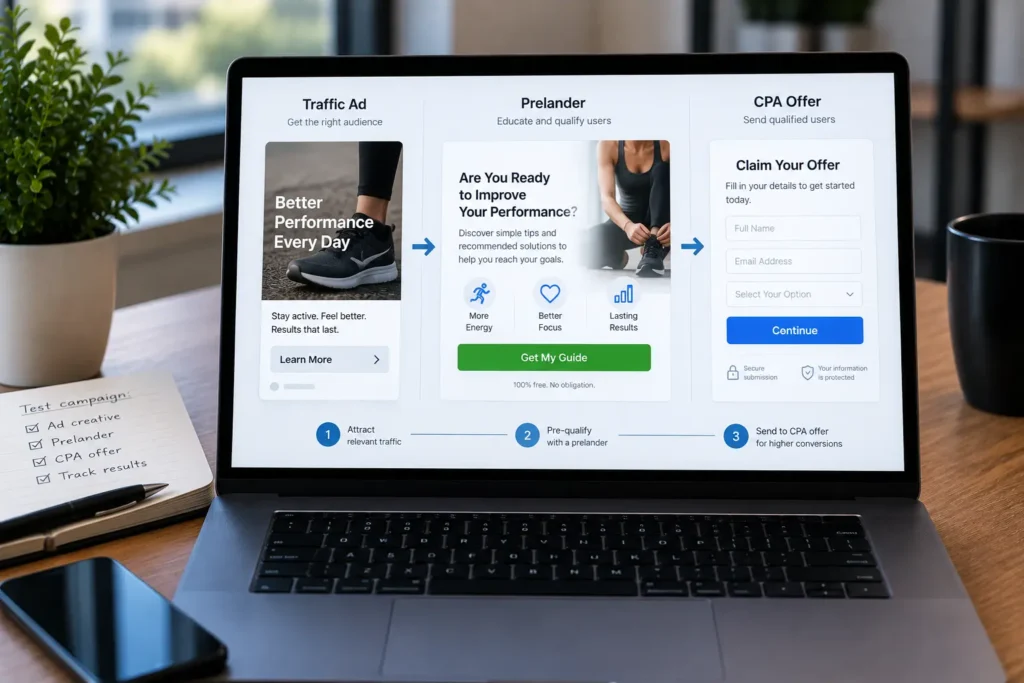
The traffic is not always invalid – sometimes the user is just not qualified enough and therefore is not the best choice for the offer. However, he can have a perfectly valid connection.
Let us take a closer look at the journey to see which step does not work right:
- Does the visit seem to be valid? There should be no hints of bots or suspicious activity, nor repeated click actions.
- Do the user and the campaign match? GEO, device, language, traffic source, and all other criteria must align.
- Check engagement – the user might be a real person, but he might not be genuinely interested, so see if he interacts with the page and don’t rely on a single metric.
- Do they go towards the offer? CTA clicks and prelander-to-offer behavior can indicate whether there is sufficient intent to continue.
- Check the conversion performance. Compare CR across various sources and sub-sources to identify when quality declines.
- See what happens next after the conversion. Approval rate, rejected actions, duplicates, and other quality metrics will give you information not visible in click metrics.
Thus, it becomes easier to define the course of action. Suspicious actions must be checked as potential fraud. Non-matching users can be filtered out or redirected. When targeting seems fine, but engagement is low, the problem may lie in the creative, placement, or prelander. Finally, in case of strong engagement and low conversions, it is worth checking the relevance of the offer, page continuity, and conversion step.
This helps identify the root cause of the poor performance rather than putting everything into a “bad traffic” bin.
How to Segment Traffic Before Matching It to CPA Offers
Blended averages of campaigns will also hide areas that perform really well and those that don’t perform at all. When traffic is segmented, it becomes clearer which areas may be eligible for changes in user behavior and monetization, making the decision easier for affiliates.
Segment by GEO, Device, OS, and Language
Start with those that are most likely to influence eligibility and usability:
- country;
- relevant region if it exists;
- language;
- mobile/desktop;
- operating system;
- browser if relevant;
- connection/carrier if it significantly affects the funnel.
Traffic from all over the world should rarely be considered as a separate performance pool. What appears to be average traffic on the worldwide level may consist of just one good GEO and several poor ones. Vice versa – one weak device or region can spoil the entire campaign that appears to be strong as a whole.
With mixed traffic, an automatic offer distribution may help reduce the amount of routing required. Adverten’s article on Smartlink vs Direct Offers shows how Smartlinks can automatically distribute traffic based on country, device type, OS, and other factors, while direct offers require more manual routing.
Segment by Traffic Source and Placement
Traffic Source represents the user’s origin; however, Placement and Sub-source indicate where the quality issue lies.
Some examples of useful source types are:
- social;
- search;
- native;
- push;
- owned sites;
- email;
- referral traffic;
- placement;
- publishers IDs;
- ad group, campaign, creative, or sub-source type.
This should be maintained throughout your tracking process. The Manual Tagging section in the Google Analytics documentation shows how UTM parameters can be used to track source, medium, campaign, term, and content. Affiliate tracking and postbacks will include additional parameters, but the same principle applies: maintain sufficient source information to track performance changes.
Match User Intent to the CPA Conversion Event
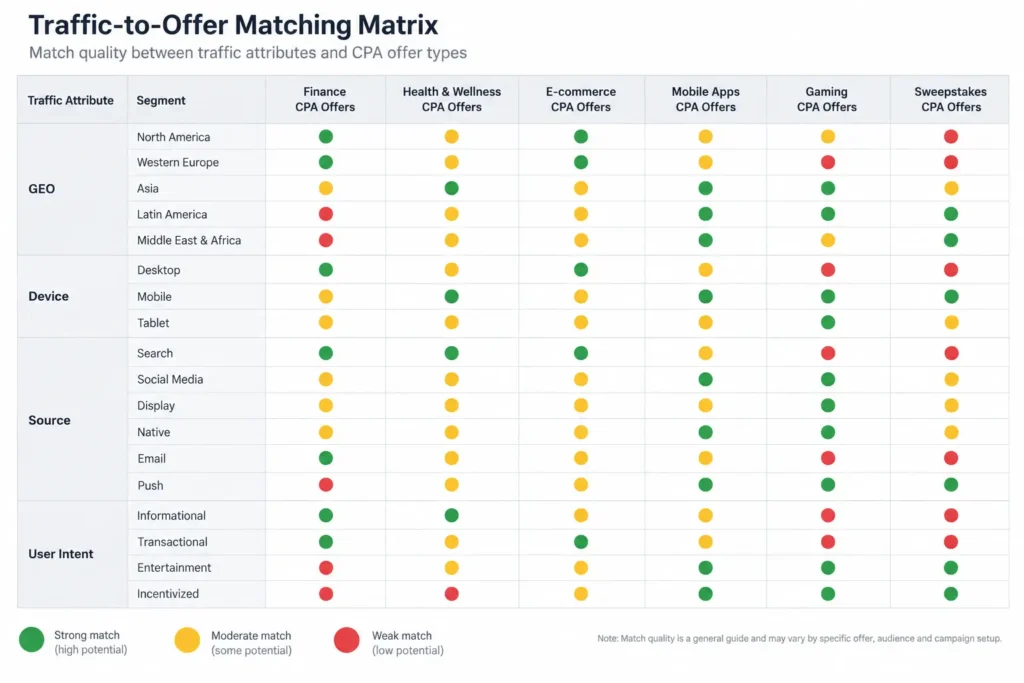
Traffic must be matched not only vertically but also according to the effort required for conversion itself.
A user who is prepared to register for a simple form fill is not necessarily prepared to:
- fill out a thorough lead form;
- begin a trial;
- purchase a product;
- pay;
- subscribe;
- validate their credentials.
Commitment plays an increasingly important role in messaging alignment and pre-qualification.
| Traffic Characteristic | Likely Intent | Offer Requirement | Recommended Action |
|---|---|---|---|
| Broad discovery traffic | Low to moderate | Simple lead or registration | Add context and qualify before sending |
| Niche content traffic | Moderate | Lead, registration, or trial | Match page message closely to the user’s topic |
| Returning engaged users | Moderate to high | Trial, purchase, or subscription | Use stronger CTA and direct intent matching |
| Mixed worldwide traffic | Mixed | Multiple GEO/device-specific offers | Use segmentation or Smartlink routing |
| High-intent targeted traffic | High | Specific direct offer | Consider tighter funnel control and offer-specific creative |
However, payout cannot be the sole consideration. An offer with a higher payout may result in lower overall earnings due to mismatched traffic. A more important consideration would be what offer provides the best combination of conversions, quality approvals, and earnings for that particular traffic segment.
How to Optimize the Pre-Offer Funnel
Affiliate traffic optimization before the offer is most useful when it helps create continuity from acquisition to conversion. The user must know the reason for clicking, the action they are supposed to take afterward, and their realistic expectations. Once that is clear, it becomes easy to determine the low-intent clicks and qualified users.
Use a Prelander to Pre-Qualify Traffic
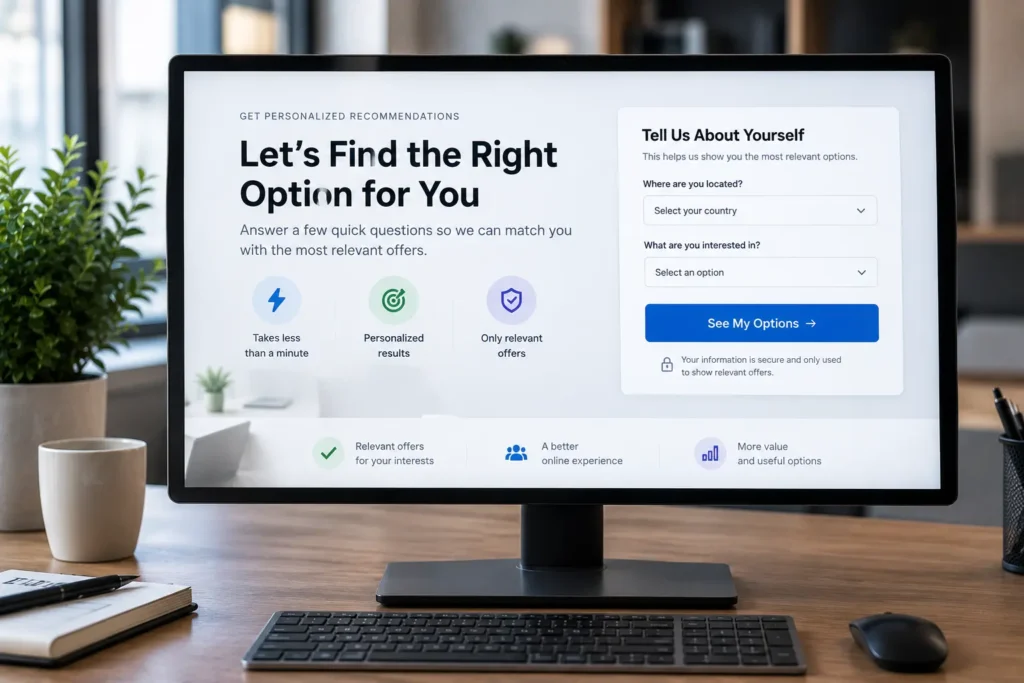
The prelander may carry out some functions before offer delivery:
- provide context;
- articulate the value proposition;
- align the user’s expectations with the page that follows;
- filter out those users who have no interest in what you offer;
- gather engagement statistics and statistics by sources;
- separate high-intent users from curious users;
- serve as a clean canvas for testing the headline, layout, and CTA.
Adverten’s guide to Smartlink and prelanders explains that the prelander is a transitional page from the traffic source to the network. According to this article, it allows the affiliate to provide a source-unique experience, filter out bots and non-targeted audiences, and gather statistics from multiple traffic sources.
However, this does not imply that all campaigns need a fancy prelander. Perhaps high-intent traffic may convert more efficiently with less intermediation.
Keep Creative, Prelander, and Offer Intent Aligned
There should be only one story throughout the process, from the moment the user sees the advertisement to the offer itself. There should be consistency between the promise made in the creative, the prelander, the call to action, and the offer itself.
Test your entire flow before scaling:
- Does the creative promote the same benefit as the prelander does?
- Does the prelander prepare the user for the actual conversion event?
- Is the CTA true to the next step in the process?
- Does the final offer align with what the user expected based on his journey?
- Is there consistency in the language, device experience, and GEO across all steps?
- Are there no exaggerated claims that just serve to improve CTR?
Inconsistency can lead to impressive top-of-funnel performance but poor business results. While a creative that uses curiosity to capture viewers’ attention can generate higher CTRs, viewers may abandon the prelander once they discover it does not match the offer. Promising results in the CTA and then making them fill out a lengthy registration form can lead to the same outcome.
Consistency in messaging helps generate good traffic from affiliate channels, since users can self-select.
Test Before You Scale
It’s important to keep things simple and try to make your test answer only one question at a time.
Examples of useful test variables are:
- creative idea;
- headline;
- CTA copy;
- prelander template;
- loading speed;
- targeting parameter;
- GEO;
- device;
- source;
- placement or sub-source;
- offer or Smartlink path.
It’s undesirable to change multiple important parameters at once, unless you want to compare full-funnel packages. If the creative, prelander, targeting, and offer are changed together, a successful test means the winning combination outperforms the losing one. Still, it does not show exactly which part performs better.
Make sure the traffic volume is sufficient to avoid anomalies from random fluctuations, especially at low conversion rates.
The aim of testing is not to get the biggest CTR on its own. The best variant would be the one that outperforms the others in downstream funnel performance: relevant visits, engaged visitors, offer clicks, conversions, approvals, and sustainable EPC/EPM.
Affiliate Traffic Quality Examples and Common Mistakes
Real-world campaign problems do not present themselves through any single metric. The juxtaposition of top-of-the-funnel acquisition metrics with engagement, conversion, approval, and revenue metrics provides better visibility into where the drop starts. It is amazing how differently similar traffic streams can perform when analyzed separately along funnel parameters such as source, GEO, device, and intent.
Example 1: High CTR but Low CPA Conversion Rate
Look at a campaign with a high CTR and fairly cheap clicks. Initially, the traffic seems to work well. However, the prelander statistics show poor engagement and a low CTR from the prelander to the offer. The final offer conversion rate is lower than average for this source.
Potential reasons might include:
- excessive promise in the creative;
- promising curiosity to the user;
- a target audience too broad for the offer;
- placement, making users click accidentally;
- the lack of correlation between ad and prelander;
- too high a level of commitment required in the final offer.
First of all, one should not purchase more of such clicks simply because they are cheap. One needs to split the source by placement, creative, GEO, and devices. Then, compare engagement rate and CTR from prelander to offer. Finally, test new creative or prelander.
If CTR drops while CR and EPM increase, traffic will become more commercial despite a less appealing campaign at the click level.
Example 2: Smaller Segment With Higher Traffic Quality
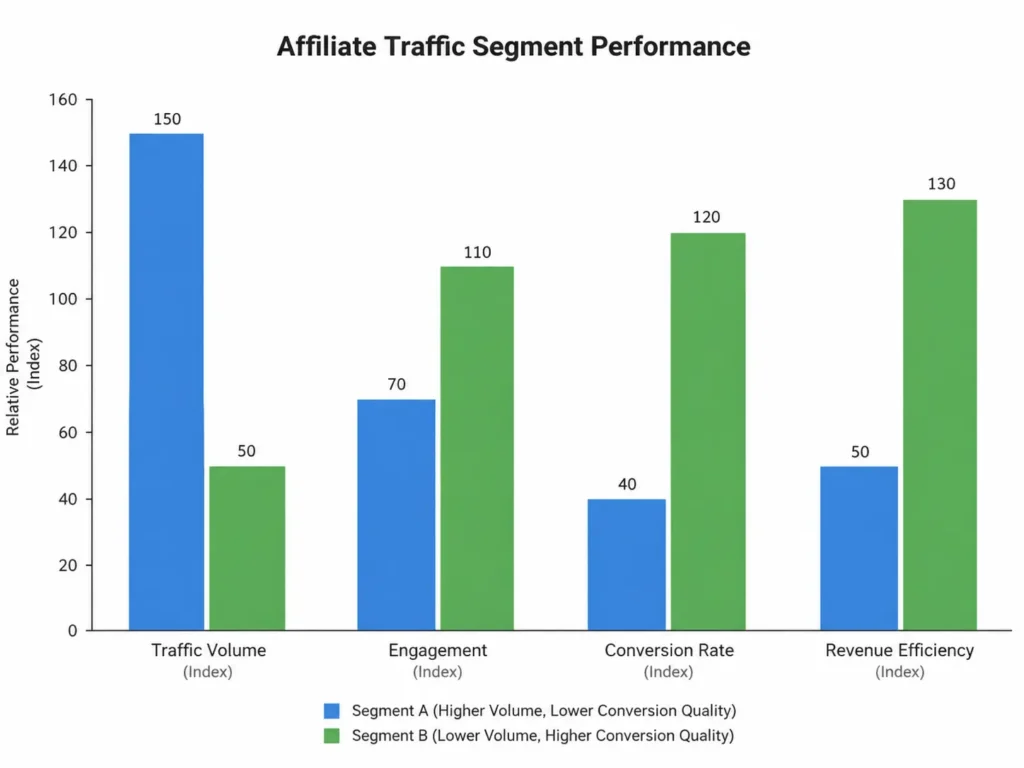
Sometimes, a smaller traffic segment can be worth more than a large one. So, having segmented a campaign by GEO and device, it might turn out that a smaller segment brings fewer visits but is more expensive, yet works better because the users in this traffic are more relevant to the offer.
The following advantages might be visible in such a case:
- Better prelander interaction;
- Higher CTR on an offer link;
- More appropriate audience for the campaign message;
- Fewer irrelevant placements;
- Better consistency in terms of approved conversions;
- Revenue stability.
In such a situation, it might be beneficial to pay more attention to the smaller traffic segment rather than trying to increase traffic from the worse one.
It doesn’t always make sense to increase your volume; sometimes it is more important to work on certain GEOs, devices, placements, and audiences.
It does not matter which segment sends you more users; what really matters is how much value your traffic brings.
Common Traffic Quality Mistakes
Some common errors include:
- Focusing solely on CTR optimization;
- Trying to get the cheapest possible clicks without considering their quality down the line;
- Combining GEOs into one performance metric;
- Ignoring mobile and desktop differences;
- Not retaining source/subsource data;
- Sending multi-purpose traffic to a tough offer;
- Switching up a campaign too soon without enough data gathered;
- Not paying attention to any postback/downstream conversion data;
- Treating all conversions equally even though they are not approved at the same level;
- Scaling placements that are unstable.
| Traffic Quality Problem | Likely Cause | Metric to Check | Practical Fix |
|---|---|---|---|
| High CTR, low CR | Misleading creative or weak intent | Prelander engagement, offer CTR, CR | Tighten message and qualification |
| Strong CR, low approval | Poor conversion quality or duplicates | Approval/rejection reasons | Audit source and conversion patterns |
| Good campaign average, unstable revenue | Weak sub-source hidden in aggregate | EPM/EPC by placement | Split and pause weak placements |
| High bounce/low engagement | Poor match or page problem | Engagement by device/source | Check speed, UX, and message continuity |
| Volume rises, EPM falls | Marginal traffic is weaker | EPM by acquisition cohort | Scale only qualified segments |
| Many users cannot reach a valid offer | GEO/device mismatch | Eligibility by source | Filter or reroute before offer delivery |
Affiliate Traffic Quality Statistics, Benchmarks, and Expert Tips
External benchmarks serve only for context, not as benchmarks for the entire industry. The make-up of the traffic is unique from source to source, from market to market, from device to device, from funnel to funnel, and from vertical to vertical. Therefore, marketing campaigns should be based on comparisons with internal metrics. Industry reports can be useful as they reveal industry-wide risks.
What Industry Statistics Tell Us About Traffic Quality
Several recent datasets provide a reason affiliates need to stop assuming that every single click or request is from a qualified human user.
Key findings in the 2026 Thales Bad Bot Report include the following:
- bots made up 53% of internet traffic in the analyzed environment;
- bad bots made up 40% of internet traffic;
- Thales blocked 17.2 trillion bad-bot requests in 2025;
- AI-enabled bot attacks increased by 12.5 times year over year.
These numbers reflect the statistics in Thales’ environment and illustrate why automated clicks are a material measurement problem, but are not a benchmark for the expected bot rate in a specific affiliate program campaign.
Another big-picture view can be found in Cloudflare’s 2025 Radar Year in Review report. AI bots constituted 4.2% of all HTML requests for Cloudflare customers during 2025, and non-AI bots started off the year making up about 50% of HTML page requests. As Cloudflare also notes, not all bots are malicious, since some are verified crawlers and other types of automated traffic.
This is a crucial difference. Automated traffic is not necessarily fraud, and global bot rates cannot be used as benchmarks for measuring fraud in campaigns.
Use Your Own Baseline Before External Benchmarks
The external studies clearly indicate a risk of poor traffic quality. However, they will not provide you with the norm of the CR or EPM for your campaign.
Create internal baselines through:
- CR split by source/subsource;
- EPC/EPM split by GEO;
- engagement split by device;
- invalid/suspicious traffic ratio;
- quality of conversion approval/validation;
- visitor revenue;
- cost per valid conversion if the cost information is available;
- performance before and after significant creative or routing changes.
Comparisons need to be apples-to-apples. Mobile social segments in one GEO need to be compared first against their own history, not against industry-wide averages or desktop search campaigns in a different market.
Expert Tips for Improving Affiliate Traffic Quality
There are several methods that improve the reliability of traffic quality analysis:
- Start measuring first and optimize later. Untracked sources and broken postbacks can make your quality analysis meaningless.
- Make sub-sources visible. The average for the campaign as a whole can hide the source of the issue.
- Separate GEO and device performance. Mixed traffic leads to distorted metrics.
- Check downstream quality rather than number of conversions. Approved actions are more important than conversions.
- Do not grow traffic from CTR. High CTR does not necessarily indicate relevant traffic; it can also indicate aggressive creatives.
- Test one major variable at a time. Clean testing gives much better information to learn from.
- Protect tracking parameters through all the redirects. Gaps in attribution can make good and bad traffic look the same.
- Be careful about sharp distribution changes. Changes in device, network, placement, and time distributions can be a red flag.
- Write down test conditions. Results become more valuable when you know the source, date range, GEO, and funnel used in testing.
- Compare net monetization efficiency. CR, EPC, EPM, validation quality, and cost should be analyzed together.
Affiliates in Smartlink campaigns can benefit from real-time reporting or postback for the feedback loop. According to Adverten, its Smartlink selects offers based on traffic features and allows partners to monitor results in real time, which makes source-level data particularly valuable before traffic volume grows.
Case Study: Improving Traffic Quality Before CPA Offer Delivery
This marketing campaign starts with a common issue: all traffic appears to be okay, but the blended data fails to show the distinctions among placements, geo locations, and devices. When the sales funnel is broken down into source-specific segments, it will be easier to fix the problem.
Campaign Baseline and Traffic Quality Problem
This campaign brings traffic from various placements into a single pre-offer funnel. The first report demonstrates impressive growth in clicks; however, this blend does not account for distinctions among the sources.
Once segmentation is done, it becomes clear that the traffic has the following four red flags:
- there is a source which brings a great number of clicks but almost no engagement;
- users of another placement belong to the wrong GEO/device combination;
- creative brings a high CTR but the prelander-to-offer CTR is low;
- conversions grow more slowly than traffic, making EPM weaker.
In this way, the baseline should be measured by source, subsource, GEO, device, engagement, offer CTR, CR, and EPM before making any changes. Otherwise, the affiliate cannot evaluate the success of his intervention.
What Was Changed Before Traffic Reached the Offer
A quality-first CPA campaign optimization process should include the following adjustments:
- Keep sub-source tracking intact. Each placement should remain trackable via prelander and conversion path.
- Pinpoint the bad placement. Decrease or stop sending traffic to that placement due to high click volume and low engagement rate.
- Break down GEO and device categories. No more judging traffic by combined average.
- Exclude users that are ineligible. Do not allow unqualified users to access the same conversion path as eligible users.
- Coordinate creative with prelander. Move away from curiosity-based messaging towards more accurate messaging about the upcoming offer.
- Clarify CTAs. Give users clear instructions on what to do before they get to the offer.
- Test routing again. Send traffic via direct offer or Smartlink route accordingly.
- Evaluate downstream quality. Compare CR, EPC/EPM, and approval quality of traffic after making these adjustments.
Results and What the Test Proved
Once the poor positions have been identified, better targeting and messaging continuity are achieved, and a healthier campaign can result in less overall traffic but more consistent performance from engagement to conversion.
| Metric | Before Optimization | After Quality-First Optimization | What the Change Means |
|---|---|---|---|
| Traffic volume | Broad and growing | Lower or more controlled | Weak traffic was removed or separated |
| Source visibility | Blended | Segmented by sub-source | Problems can be traced to specific inventory |
| Engagement | Uneven | More consistent | Message and audience fit improved |
| Offer CTR | Weak on some segments | Stronger among qualified users | Prelander filters intent more effectively |
| CR | Volatile | More stable | Traffic-to-offer match improved |
| EPC/EPM | Declining with scale | More consistent | Added traffic contributes more value |
| Approval quality | Difficult to diagnose | Reviewed by segment | Downstream feedback becomes actionable |
The takeaway from this case is that traffic quality can be optimized once you know which stage has become faulty and address it accordingly. Removing poor-performing placements does not solve the problem of poor copy in your creative. Improved targeting will not help in resolving incorrect attribution. Prelander cannot solve the problem of the irrelevant offer.
The key takeaway here is that no single optimization will resolve all traffic quality problems. The solution lies in developing a transparent flow from source to monetization and fixing the first flawed stage.
Conclusion: Build Traffic Quality Before You Scale CPA Campaigns
Effective affiliate traffic optimization does not mean achieving maximum clicks; it involves identifying which users, GEOs, devices, placements, and traffic sources drive conversions and revenue.
Make sure tracking is set up correctly, unsupported traffic is filtered, key segments are isolated, and users see offers relevant to their intentions before trying to scale CPA campaigns. A campaign with lower volume but higher relevancy can work better than one with high volume of cheap traffic.
CTR and conversion rates at the very beginning of a campaign are not enough to determine whether the traffic is good or bad. For CPA campaign optimization, engagement rates, CR, EPC or EPM, approval quality, and source performance are needed to make this decision based on more reliable data. When all the above-mentioned parameters remain constant as traffic volume increases, scalability will be less risky.
When the campaign includes multiple GEOs, devices, or traffic sources, using Smartlink routing simplifies offer distribution and traffic monetization. Adverten allows you to analyze traffic, select the best offers for it, and monitor postbacks and traffic monetization worldwide thanks to the Smartlink platform.
You can read more about the differences between Smartlinks and direct offers, or how to use prelanders for Smartlink traffic, here.
FAQ About Affiliate Traffic Quality and CPA Offers
Can a sudden drop in conversion rate indicate poor traffic quality?
A rapid decline in conversion rate might be caused by poor traffic quality, but it does not prove it on its own. Analyze the shift at the source, placement, GEO, device, and creative levels, and see whether changes in engagement and other traffic quality metrics occurred simultaneously.
What is the difference between low-intent traffic and invalid traffic?
Invalid traffic is fake traffic, while low-intent traffic is valid traffic showing no intent to use the offer. It can result from broad targeting, misalignment between creative and the offer, and placement that is not suitable for the campaign. The idea is to detect such segments and use affiliate traffic filtering or routing instead of recognizing them as fraudulent.
Does GEO affect affiliate traffic quality?
Sure. GEO can significantly impact affiliate traffic quality, as users differ in intent, language, device preferences, buying habits, and offer availability. Adverten can assist in routing global traffic towards offers suitable for them.
When should affiliates use a prelander before a CPA offer?
This tool is needed when visitors require additional information before receiving the offer. A prelander helps introduce the next step, set expectations, and determine who is ready to move forward. It can also support affiliate traffic optimization by helping separate stronger-intent users from weaker ones.
Why is sub-source tracking important for traffic optimization?
The traffic source level allows understanding of where traffic is coming from, while the sub-source level shows exactly which part of that source generates it. Preserving both traffic levels helps separate bad traffic without shutting off the entire source with profitable segments.
Can a high-performing creative still bring low-quality traffic?
Yes. Despite attracting click-throughs, a creative will also reduce traffic quality if its promise doesn’t align with the landing page or the CPA action. Messages that are misleading or too broad will generate curiosity clicks that engage badly and convert inconsistently on the landing page.
Why does offer matching matter for affiliate traffic quality?
Offer matching matters because even valid traffic can perform poorly when the user’s intent does not align with the required action. Adverten Smartlink uses traffic signals to direct users toward more relevant offers, which can help improve affiliate traffic quality without treating every visitor as part of a single, identical audience.
How long should affiliates test traffic before scaling?
Use a test period long enough to collect meaningful data for each segment rather than relying on a fixed number of hours or days. Compare CR, EPC or EPM, engagement, and approval quality, and avoid scaling when results are still being driven by only a small number of conversions.
What should I do when one traffic placement performs poorly?
When one placement performs poorly, isolate it before changing the whole campaign. Review its targeting, creative, engagement, conversion rate, and downstream quality. This makes cpa campaign optimization more precise because weak placements can be adjusted without affecting stronger segments.
Can Smartlink routing improve traffic quality?
Traffic quality can improve when routing becomes more relevant, but automation still depends on clean inputs and reliable tracking. Adverten combines Smartlink routing with real-time traffic analysis, making it easier to compare segments and direct users toward suitable monetization paths.